

Sri Lankan government plans modern bus fleet to improve public transport
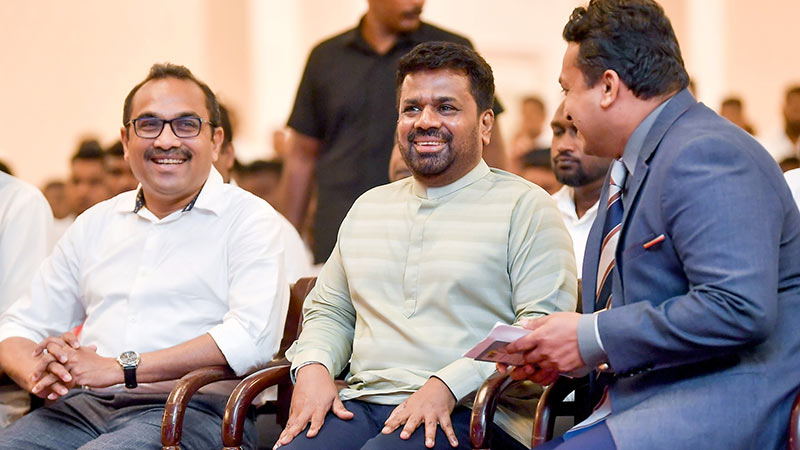
Sri Lanka President Anura Kumara Dissanayake stated that the Government expects to establish a strong public transport system that is comfortable, safe, efficient and reliable for the people.
He said the Government is currently preparing a national policy to achieve this objective.
The President also noted that plans are being prepared to introduce new buses that meet proper standards while gradually removing older buses from the transport system. Although this cannot be done immediately, he said that through a planned process over several years the Government aims to provide the public with a modern and high-quality bus fleet.
President Anura Kumara Dissanayake made these remarks while attending a ceremony held this morning (March 10) at Temple Trees in Colombo to present letters of appointment to 199 newly recruited drivers and 342 conductors representing all districts for the Sri Lanka Transport Board (SLTB).
During the event, the President symbolically presented letters of appointment to several recipients.
Recalling the strong emotional bond that once existed between the people of Sri Lanka and the SLTB, the President expressed confidence that the new recruits would help rebuild the institution, which he said had weakened over time due to political appointments and irregular practices. He also congratulated the newly appointed drivers and conductors.
Addressing the gathering, the President said that the SLTB has historically maintained a close relationship with the public and that those joining the service now carry the responsibility of restoring its standards and reputation.
He said improving the SLTB cannot be achieved through technology alone, noting that drivers and conductors must treat passengers in a friendly and responsible manner while ensuring their safety.
The President stated that a strong public transport system is essential for several reasons. Transportation costs remain a heavy burden for many households, and uncertainty about the reliability of public transport encourages people to purchase private vehicles, increasing their expenses.
He also noted that Sri Lanka spends a large amount of foreign exchange on vehicle imports and that a stronger public transport system could help reduce this cost.
Environmental protection is another important factor, he said, adding that reducing the number of vehicles on the roads would help decrease air pollution caused by emissions.
The President also highlighted traffic congestion as a major issue, noting that large numbers of productive hours are lost on roads due to heavy traffic. Strengthening public transport, he said, would help reduce congestion and improve economic productivity.
He further stated that the Government is currently preparing a national policy relating to buses to ensure proper standards in passenger transport. If buses operate without standards or are overcrowded, the public will avoid using them despite efforts to promote public transport, he said.
President Dissanayake noted that the Government plans to gradually replace older buses with new ones that meet required standards. This transition will be carried out over several years in a planned manner.
He also stressed that the behaviour and professionalism of drivers and conductors must reach a higher standard, noting that passengers entrust their safety to them. The Government will not allow buses to be operated recklessly or under the influence of drugs, he said, adding that necessary laws and inspections will be implemented.
The President said the Government aims to provide a comfortable, efficient and reliable public transport service with punctual and continuous operations.
He announced that eight new buses provided by the Government of Japan are expected to arrive this month, while additional buses ordered by the Government are scheduled to arrive in August and September.
The Government also plans to establish a new company to provide comfortable passenger transport services, while older buses will be gradually removed from urban areas and replaced with a modern fleet for short-distance city operations.
The President noted that public transport should function as a coordinated partnership between the public and private sectors under proper regulation to ensure quality services.
He added that the Government has allocated approximately Rs. 2 billion in the current budget to provide subsidies for transport services on rural routes.
SLTB Chief Executive Officer M. A. N. Dhammika Ratna, speaking at the event, said the institution is working to strengthen the state transport service.
He said the SLTB currently operates 7,130 buses, of which more than 70 per cent are over ten years old, including 3,848 buses that are more than 12 years old.
The event was attended by Minister of Transport, Highways and Urban Development Bimal Rathnayake, Deputy Minister of Urban Development Eranga Gunasekara, Members of Parliament Prageeth Madhuranga, Chandana Sooriyarachchi and Dhanushka Ranganath, SLTB Chairman Jeevaka Prasanna Purasinha, and senior officials of the Ministry of Transport and the Sri Lanka Transport Board.