
Agriculture offers Sri Lanka’s strongest investment potential – Chathuranga
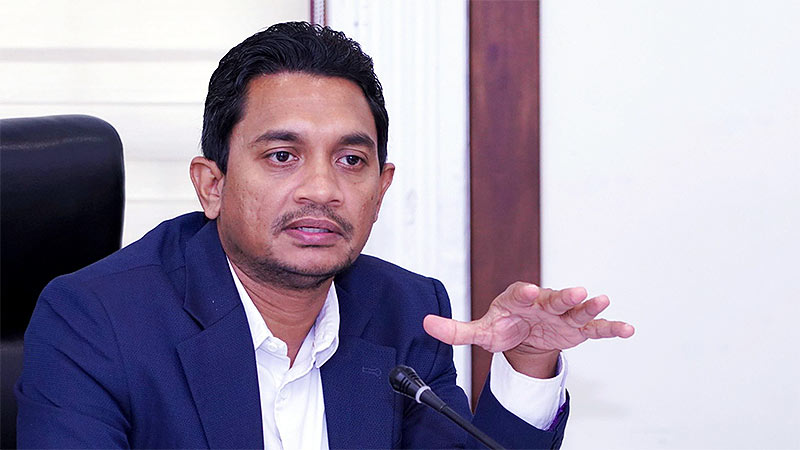
Deputy Minister Chathuranga Abeysinghe
Deputy Minister of Industry and Entrepreneurship Development Chathuranga Abeysinghe says agriculture offers some of the strongest investment potential in Sri Lanka, with opportunities to raise productivity, increase export value and generate higher returns.
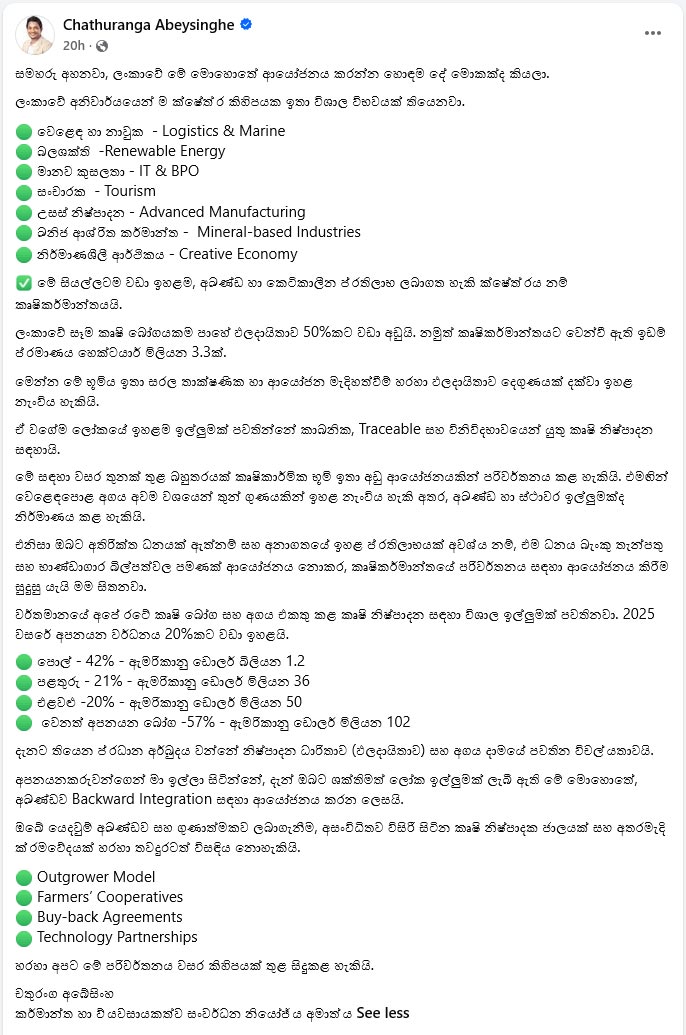
In a Facebook post published on August 31, 2026, Abeysinghe said Sri Lanka has significant investment potential in several sectors, including trade, logistics and marine activities, renewable energy, IT and BPO, tourism, advanced manufacturing, mineral-based industries and the creative economy.
However, he said agriculture could provide the highest, continuous and relatively short-term returns among these sectors.
According to Abeysinghe, the productivity of almost every agricultural crop in Sri Lanka is more than 50% below its potential, while around 3.3 million hectares of land are currently used for agriculture.
He said productivity on this land could be increased by up to two times through relatively simple technological and investment interventions.
Abeysinghe also pointed to strong global demand for organic, traceable and transparently produced agricultural products.
He said a large share of Sri Lanka’s agricultural land could be transformed to meet such demand within three years with relatively low investment.
According to him, such a transformation could increase the market value of agricultural products by at least three times while also creating continuous and stable demand.
Abeysinghe said people with surplus wealth who are seeking higher future returns should consider investing in the transformation of agriculture instead of placing their funds only in bank deposits and Treasury bills.
He also said there is currently strong demand for Sri Lankan agricultural crops and value-added agricultural products, adding that export growth in 2025 exceeded 20%.
According to the figures shared by the Deputy Minister, coconut exports recorded 42% growth and reached USD 1.2 billion, while fruit exports increased by 21% to USD 36 million.
Vegetable exports grew by 20% to USD 50 million, while other export crops recorded 57% growth and reached USD 102 million.
Abeysinghe said the main challenge at present is production capacity, or productivity, as well as variability within the agricultural value chain.
He called on exporters to invest continuously in backward integration at a time when global demand remains strong.
He said ensuring a continuous supply of high-quality inputs can no longer be effectively managed through a scattered and unorganised network of agricultural producers and intermediary systems.
Abeysinghe proposed several approaches to address the issue, including outgrower models, farmers’ cooperatives, buy-back agreements and technology partnerships.
He said these measures could help transform Sri Lanka’s agricultural sector within a few years.