

Sri Lanka court told ex-intelligence chief Suresh Salley linked to Easter Sunday attacks
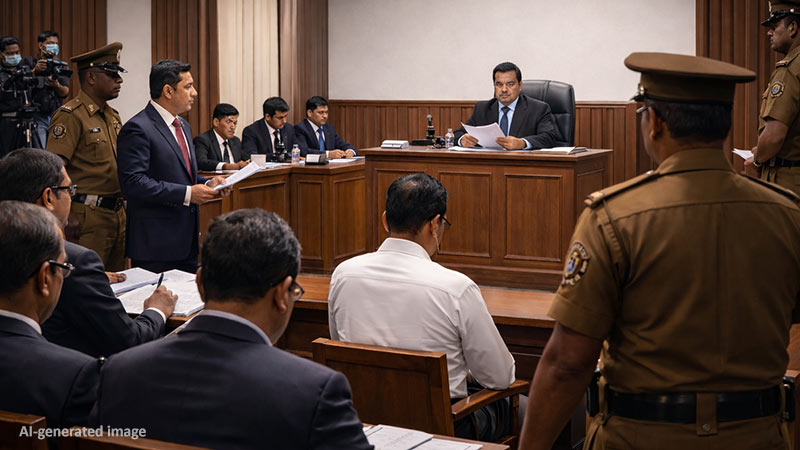
AI-generated image
Former Director of the State Intelligence Service (SIS), Retired Major General Suresh Sallay, who is currently detained under the Prevention of Terrorism Act (PTA), is facing allegations directly connected to the 2019 Easter Sunday terror attacks, the Colombo Fort Magistrate’s Court was informed yesterday (March 11).
Colombo Fort Magistrate Isuru Neththikumara made this observation when the Criminal Investigation Department (CID) presented its progress report on the ongoing investigation into the Easter Sunday bombings before court.
The Magistrate noted that the matters raised against Sallay do not relate to dereliction of duty or other unrelated issues, but instead concern allegations of direct links to the Easter Sunday attacks.
According to the CID, investigations have revealed that Sallay was allegedly involved in gathering information for the group led by Zahran Hashim ahead of the attack on St. Sebastian’s Church in Katuwapitiya. The CID stated that this was done through one of his informants.
In a statement presented to court, the investigation officer said an informant maintained by an intelligence unit in the Panadura area had provided advance warning that the attack would take place. On the day of the attack, the informant allegedly told officers that an Army officer with at least 20 years of experience was behind the attack.
Senior Army officers later questioned the informant over the phone, and on April 26, 2019, he was taken into custody by Military Intelligence and subsequently handed over to the Terrorism Investigation Division (TID). The officer further stated that the informant’s household needs were later handled by Military Intelligence and arrangements were made to provide a job for his son in the Army Intelligence IT division.
The Magistrate observed that intelligence officers are legally allowed to maintain informants, but expressed concern over allegations that support continued even after the individual had become a suspect.
CID officers told the court that the suspect continued to be maintained afterward and that this process allegedly took place under the guidance of Suresh Sallay.
The investigation officer further told the court that after the informant was released on the advice of the Attorney General, he was handed over to TID officers, taken to the Galadari Hotel, thanked, and told to step away from the work.
When the Magistrate asked why the suspect was thanked, the investigation officer said the individual had been assigned to the TID for questioning and that an intelligence officer had been sent to obtain details from him about how investigations were being conducted, including how the CID and TID were carrying out their work and how foreign arrivals were conducting questioning.
The CID also told the court that Sallay had allegedly interfered in the process of confirming the death of Pulastini Rajendran, also known as Sarah Jasmine, who was linked to the Easter attacks.
According to the investigation officer, after the April 26, 2019 explosion in Sainthamaruthu, Sarah Jasmine was believed to have died, but her body was not recovered. A DNA report confirming her death was obtained only after a third attempt, and investigators allegedly faced pressure from Sallay during the process.
The CID further stated that former Inspector General of Police C.D. Wickramaratne and former CID Director Nishantha Soysa had already provided testimony about these alleged interferences, saying that Sallay repeatedly influenced officials through the National Security Council.
The Magistrate questioned how an intelligence officer could summon a police chief before the Security Council. CID officers responded that such meetings could only be convened by the President and that they were usually held based on presentations made by the Director of State Intelligence.
The investigation officer also told the court that former CID officer Prasad Ranasinghe had stated he faced pressure from Sallay regarding investigative instructions. After failing to comply, Ranasinghe was allegedly brought before the National Security Council and pressured through the President, and later suffered a heart attack due to the stress.
Representing Sallay, President’s Counsel Anuja Premaratne rejected the allegations before court.
Premaratne stated that the Easter Sunday bombing took place in 2019 and argued that raising the Katuwapitiya incident again would not add anything useful. He also said that the suspect was not in Sri Lanka at the time but was in Malaysia.
He further questioned claims that pressure had been exerted on senior police officers, including Deputy Inspectors General and the IGP, and said it was shameful to present such a narrative. Premaratne also argued that the State Intelligence Service functions under the IGP and that only the President could convene the National Security Council. He added that no Security Council meeting was held during the 2019 Easter attacks and said these matters had already been discussed before a panel of seven Supreme Court judges.
The Magistrate also questioned CID officers about the type of pressure allegedly exerted through the President at that time.
The investigation officer responded that the pressure related to instructions to exhume bodies in Ampara for a third time to obtain DNA samples. When the request was not carried out, the matter was allegedly raised at intelligence review meetings and later brought before the Security Council, where the President was reportedly informed that CID officers were deliberately avoiding the test.
Meanwhile, President’s Counsel Premaratne informed the court that lawyers had faced several obstacles when attempting to meet Suresh Sallay while he remains detained under the Prevention of Terrorism Act.
After considering the submissions made by both sides, the Fort Magistrate ordered that the case be recalled on the 25th.
In his observations, the Magistrate stated that the matters presented regarding the third suspect appear to relate directly to the Easter Sunday attacks rather than residual issues such as dereliction of duty.
He further noted that whether the evidence is sufficient must be determined based on the consolidated evidence report submitted to court and the outcome of future investigations.
The Magistrate also observed that one of the matters raised concerns actions at the National Security Council and said it must be examined whether any order given by the President through the Council falls within constitutional powers.
He stated that if such an order falls within the President’s constitutional authority, it cannot be treated as a criminal act. Criminal liability would arise only if there was an intention to obstruct investigations, adding that merely providing advice regarding investigative steps does not in itself amount to a criminal offence.
The court ordered that further inquiries be conducted to determine whether actions that took place at the Security Council amount to an offence and, if so, who bears responsibility. Investigators were instructed to report these findings to court.
The Magistrate also stated that any application relating to the third suspect must be submitted in writing in accordance with previous appellate court orders, and the court will issue further orders within constitutional limits when reviewing matters under the Prevention of Terrorism Act.