

Sri Lanka economy on path to stability, President tells IMF delegation
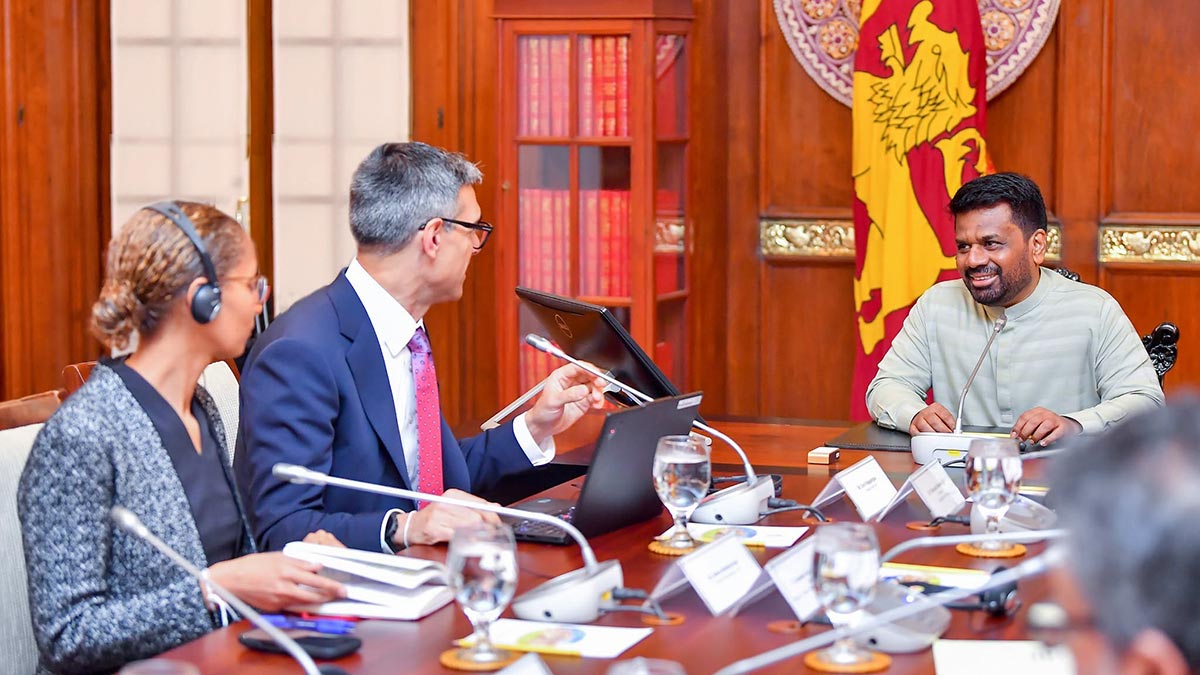
Sri Lanka’s economy has entered a path towards stability, and the government plans to use those gains to improve people’s living standards and support long-term economic transformation, President Anura Kumara Dissanayake said.
The President made the remarks during a meeting at the Presidential Secretariat in Colombo this morning (September 17) with an International Monetary Fund (IMF) delegation led by Mission Chief Evan Papageorgiou.
The IMF delegation is in Sri Lanka for the seventh review of the country’s Extended Fund Facility (EFF) programme and the 2026 Article IV Consultation. The mission is scheduled to remain in Colombo from September 10 to 23.
President Dissanayake said recent economic indicators clearly show that the country is moving towards stability. He said the government’s aim is to use this stability as a strong foundation for a new period of economic transformation.
He also said the government wants the economic gains achieved so far to help ease the financial burden on the public and improve living standards.
Papageorgiou said Sri Lanka had made significant economic progress and commended the country’s efforts to maintain fiscal discipline, increase government revenue and attract foreign investment.
He also stressed the importance of protecting the economic stability achieved so far as the country moves into 2027 and beyond.
President Dissanayake said the programme implemented by the government together with the IMF had provided an important foundation for achieving economic stability.
He said this stability had also helped Sri Lanka deal with the economic effects of Cyclone Ditwah and the impact of the conflict in the Middle East.
The President said Sri Lanka recorded economic growth of 4.2% in the second quarter of 2026, describing it as an important sign that the economy is recovering and expanding.
He also referred to the government’s tax revenue collection performance during the past two years and reiterated that the government intends to protect the economic stability achieved with IMF support.
The IMF delegation noted the progress made in implementing Sri Lanka’s social welfare benefit programme, which is an important part of the IMF-supported programme.
The meeting also discussed the difficulties faced by the public due to higher energy costs linked to the conflict in the Middle East.
The IMF delegation included Enrique Flores Curiel, Dinar Prihardini, Ursula Wiriadinata, Ozlem Aydin, Yorbol Yakhshilikov, Klakow Akepanidtaworn, Yan Chen, Martha Woldemichael, IMF Resident Representative, and Manavee Abeyawickrama, Local Economist.
Sri Lanka was represented by Central Bank Governor Dr. P. Nandalal Weerasinghe; Secretary to the Ministry of Finance, Planning and Economic Development Dr. Harshana Suriyapperuma; Senior Economic Advisor to the President Duminda Hulangamuwa; and Senior Additional Secretary to the President for Finance and Economic Affairs G.M.R.D. Aponsu.
The IMF’s latest programme documents confirm that the seventh EFF review is linked to end-June 2026 performance criteria and forms part of Sri Lanka’s four-year IMF-supported reform programme.