

Sri Lanka President vows to punish corruption, says no crime will be buried by time
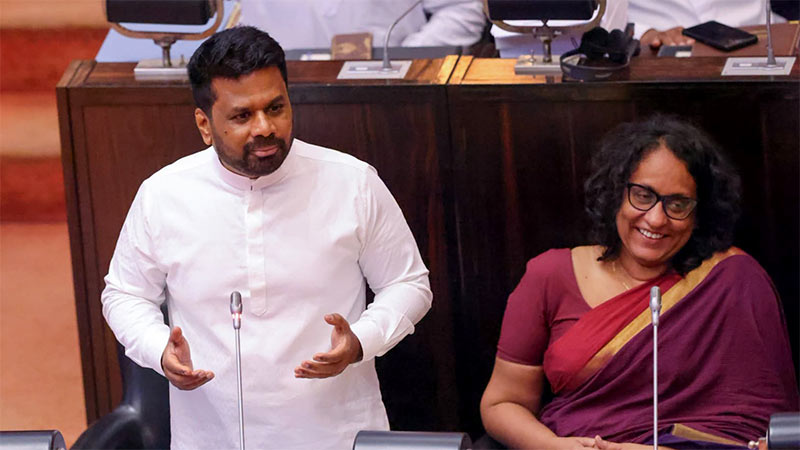
Sri Lanka President Anura Kumara Dissanayake says his government will punish those who stole public property through fraud and corruption and will not allow any crime to be buried by the sands of time.
The President made these remarks in Parliament of Sri Lanka today (June 25) during the adjournment debate on measures to combat the drug menace.
He said the people had given the government a clear mandate to build a civilized State and stressed that the administration is not seeking personal revenge against anyone. Instead, he said the government is committed to ensuring that everyone, from the President to the lowest-ranking public official, becomes part of building a civilized nation.
President Dissanayake said drug trafficking and organized crime did not grow in isolation but through networks involving criminal gangs, drug traffickers, corruption within State institutions, political influence, and criminal elements that had infiltrated the State. He said the government has decided to dismantle this entire network.
He praised several officials leading the fight against crime and corruption, including Criminal Investigation Department Director Shani Abeysekara, Commission to Investigate Allegations of Bribery or Corruption Director General Ranga Dissanayake, Public Security Secretary Ravi Seneviratne, Minister Ananda Wijepala, and Attorney General’s Department official Dileepa Peiris. He said they, along with the judiciary, have become targets of the opposition because of their work.
The President said the government respects the armed forces and intelligence services, but warned that any small group within those institutions that acted to protect political interests instead of the State would face legal action.
Referring to several high-profile cases, he said investigations into the murder of Lasantha Wickrematunge, the abduction and assault of Keith Noyahr, attacks on Upali Tennakoon and Poddala Jayantha, the murder of Wasim Thajudeen, the Easter Sunday attacks, and attacks on media institutions must continue to ensure justice for victims and protect the reputation of the armed forces. He also said crimes linked to the use of “white vans” should not be hidden.
The President said there had been a political system connected to organized crime, claiming money had been taken to have suspects killed before they could be produced in court or to promise protection from death. He also revealed that a political leader had exchanged 92 phone calls with imprisoned drug traffickers, including 54 outgoing calls. However, he did not name the individual.
He said investigations have been launched into telegraphic transfers worth nearly US$1 billion made since 2023 for goods that never arrived, adding that authorities have identified links involving several bank branches. According to the President, regulations have now been introduced to prevent such transactions, and investigations are continuing into money linked to drug trafficking, corruption, and other criminal activities.
President Dissanayake said the government has strengthened anti-drug operations, leading to major drug seizures and arrests regardless of a person’s status. He said 23 people wanted through Interpol Red Notices have been brought back to Sri Lanka, while another 35 people connected to drug trafficking have been arrested overseas and returned to the country.
He also said a new high-security prison at Welisara has been established to prevent inmates from communicating with the outside world, cutting off organized criminal networks operating from prisons. While acknowledging that eliminating organized crime would take time, he said the government has already introduced long-term and stable measures to achieve that goal and remains committed to completely eradicating organized criminal gangs, underworld networks, and drug trafficking from Sri Lanka.
The President announced that the Prevention of Terrorism Act (PTA) will be repealed this year following the completion of final discussions. He said it would be replaced by a new Organized Crime Act containing clear definitions focused specifically on organized crime while protecting fundamental rights, freedom of expression, and democratic freedoms. He also said the government will not implement the Online Safety Act in its current form and will instead introduce comprehensive amendments through a new bill already approved by the Cabinet.
Highlighting the government’s commitment to democracy, the President said water cannons and tear gas have not been used against peaceful public protests during his administration. He added that tear gas was used only once inside Matara Prison to control an attempted prison break.
Addressing concerns over vacancies in the superior courts, President Dissanayake said the government is carefully managing judicial appointments to avoid weakening lower courts. He said the Judicial Service Commission has approved the recruitment of 50 new Magistrates, with 33 candidates shortlisted so far, and assured that vacancies in the superior courts would be filled within a short period. He rejected claims that the vacancies were being kept open to influence court decisions, calling such allegations an insult to the judiciary.
The President concluded by saying the government has no intention of controlling the judiciary, the media, or public protests, and called on all citizens to support efforts to protect democracy, combat drug trafficking and organized crime, and build a civilized State.