

Sri Lanka targets US$300 Billion economy through reforms and foreign investment drive
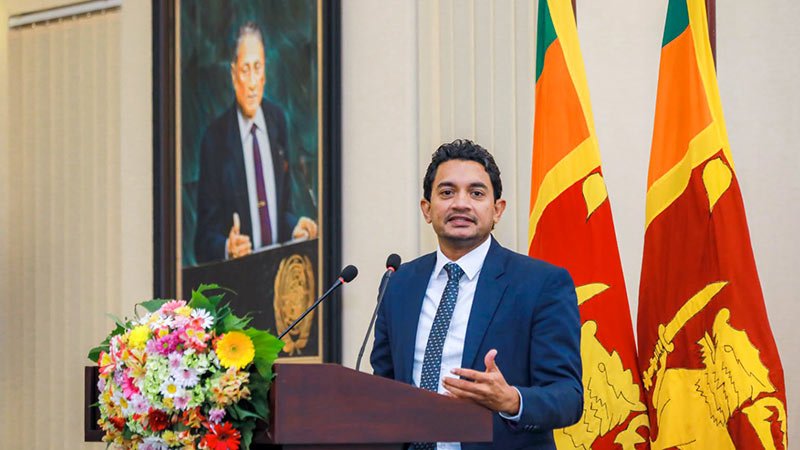
Deputy Minister of Industry and Entrepreneurship Development Chathuranga Abeysinghe
Sri Lanka aims to become a US$300 billion economy within the next decade through reforms, foreign investment, and stronger global partnerships, Deputy Minister of Industry and Entrepreneurship Development Chathuranga Abeysinghe said.
Abeysinghe made these remarks after participating in a special session on foreign investment and economic diplomacy organized by the Ministry of Foreign Affairs recently.
According to him, the main objective of the session was to position Sri Lanka as a stable and reliable partner in the global marketplace while strengthening the country’s export-driven economy.
He noted that Sri Lanka is undergoing a major economic transformation and is moving beyond the economic difficulties, corruption, and challenges experienced in previous decades. He said the people of Sri Lanka have chosen a new path based on transparency and sound policies.
Abeysinghe stated that the government is carrying out fundamental reforms across several sectors, including education, healthcare, environmental protection, and digital technology. He added that the goal is to raise Sri Lanka to the level of rapidly developing nations such as Vietnam, South Korea, and India.
He further highlighted Sri Lanka’s strategic geographic location, saying it provides significant advantages as an important hub in Asia. He also pointed to the country’s talented young workforce as a key strength for sectors such as information technology, manufacturing, and research.
The Deputy Minister said innovation and technology have long been part of Sri Lanka’s heritage, citing the ancient rock fortress of Sigiriya as an example of the engineering skills that continue to inspire modern technological advancement.
Abeysinghe emphasized the importance of building stronger partnerships with countries around the world. He said investors could gain easier access to technology and markets by working with existing local businesses rather than creating entirely new ventures.
He added that sectors such as agriculture, renewable energy, and the digital economy will play a key role in Sri Lanka’s future growth, and invited international investors to join the country’s ongoing transformation.