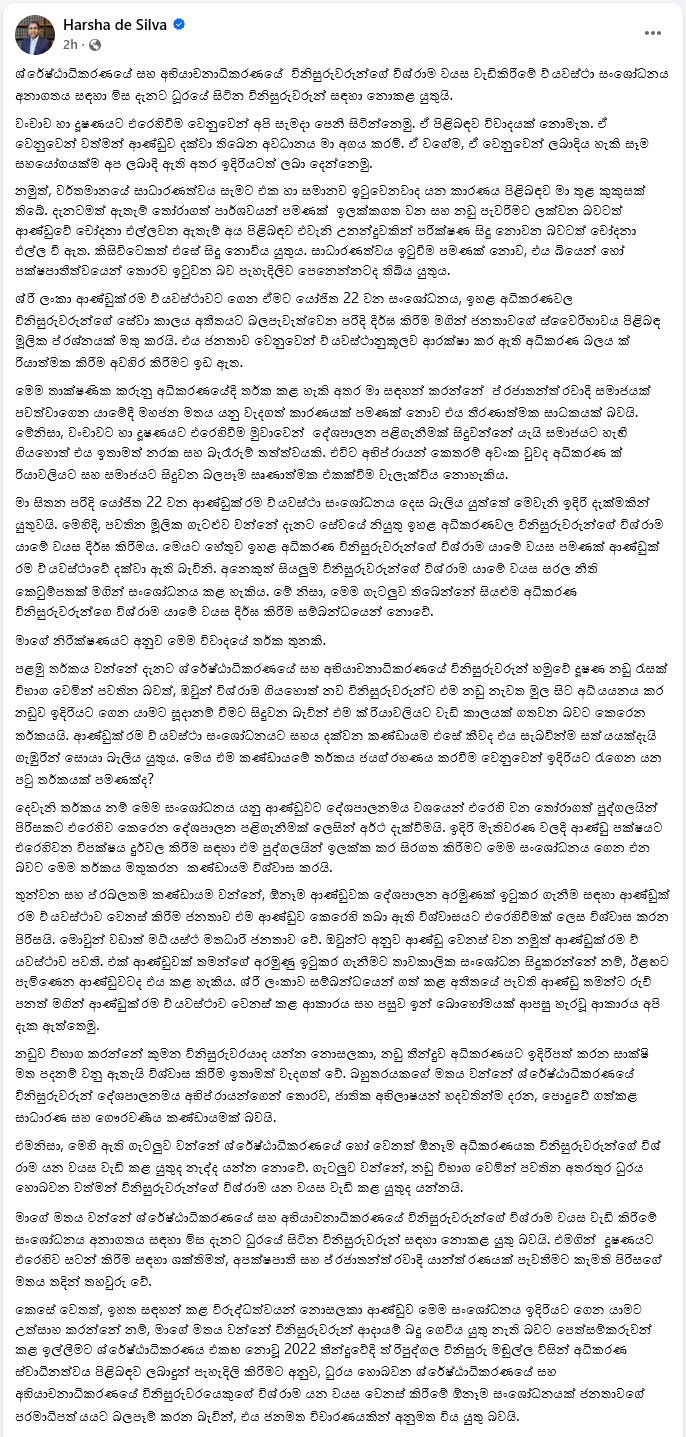

Harsha de Silva says higher retirement age should not apply to serving judges
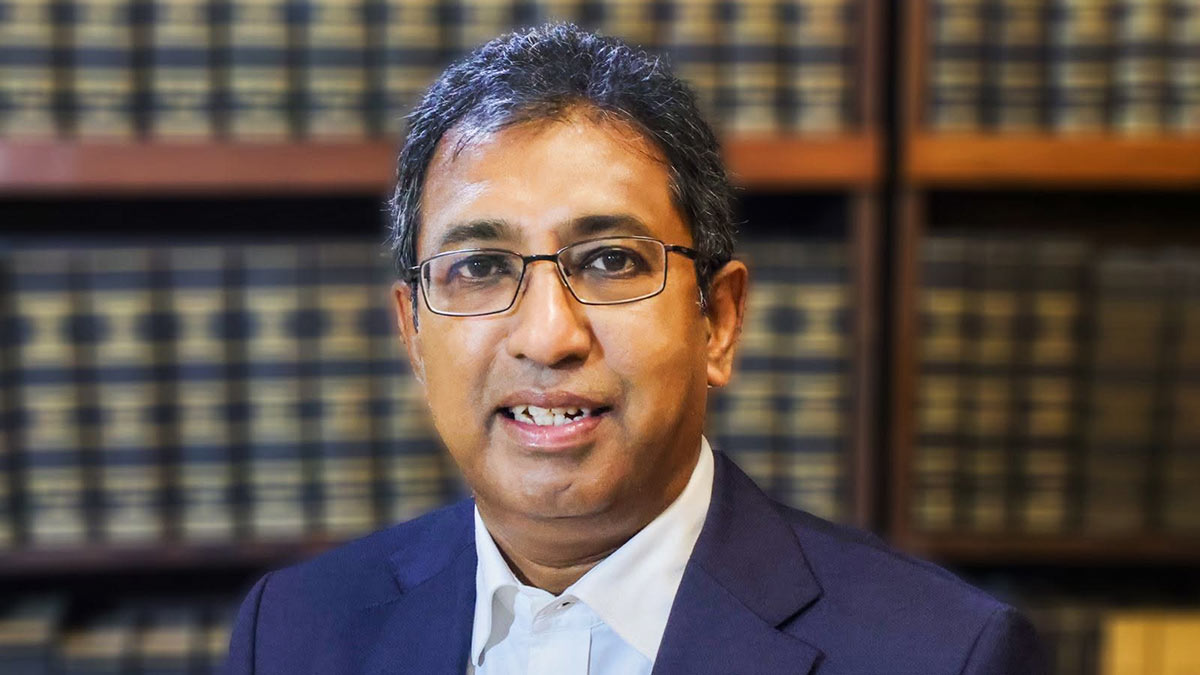
Dr. Harsha de Silva | Photo: Facebook
Samagi Jana Balawegaya (SJB) Parliamentarian Dr. Harsha de Silva says any constitutional amendment increasing the retirement ages of Supreme Court and Court of Appeal judges should apply only to future appointments and not to judges currently serving.
In a Facebook post published today (August 19), Dr. de Silva expressed concerns over the proposed Twenty-Second Amendment to the Constitution of Sri Lanka, which seeks to extend the retirement ages of judges of the higher courts.
He said he has always supported action against fraud and corruption and appreciated the attention given to the issue by the present government. He added that his side has provided support for such efforts and would continue to do so.
However, Dr. de Silva questioned whether justice is currently being applied equally and fairly to everyone.
He said allegations have been made that certain selected individuals are being targeted and prosecuted, while allegations against some individuals linked to the government are not being investigated with the same level of interest.
He stressed that justice must not only be done but must also be clearly seen to be carried out without fear or favour.
According to Dr. de Silva, the proposed Twenty-Second Amendment raises a fundamental issue concerning the sovereignty of the people because it could retrospectively extend the terms of judges already serving in the higher courts.
He said such a change could affect the exercise of judicial power, which is constitutionally protected on behalf of the people.
While noting that the legal and technical questions could be argued before a court, he said public perception is also a decisive factor in maintaining a democratic society.
Dr. de Silva warned that if the public begins to believe that political revenge is being carried out under the guise of fighting fraud and corruption, it could have a serious negative impact on both the judicial process and society, regardless of the intentions behind the measures.
He said the main concern surrounding the proposed amendment is the extension of the retirement ages of judges of the higher courts who are already serving.
Dr. de Silva pointed out that the retirement ages of higher court judges are specified in the Constitution, while the retirement ages of other judges can be changed through ordinary legislation. Therefore, he said the debate is not simply about increasing the retirement age of all judges.
He identified three main arguments surrounding the proposed amendment.
The first argument, according to Dr. de Silva, is that a large number of corruption cases are currently being heard before Supreme Court and Court of Appeal judges and that if those judges retire, newly appointed judges would need additional time to study the cases before continuing proceedings.
However, he questioned whether this argument is fully justified or whether it is being used narrowly to strengthen support for the amendment.
The second argument is that the amendment could be used as a form of political revenge against selected individuals opposed to the government.
Dr. de Silva said those who hold this view believe the amendment is intended to target and imprison political opponents in order to weaken possible challenges to the governing party at future elections.
The third argument, which he described as the strongest, is that changing the Constitution to achieve the political objectives of any government would violate the trust placed in that government by the people.
He said those who hold this view argue that governments change while the Constitution remains, and that allowing one government to make temporary constitutional changes for its own objectives could encourage future governments to do the same.
Dr. de Silva noted that Sri Lanka has previously seen governments introduce constitutional changes that suited their interests, with some of those changes later being reversed.
He said it is extremely important for the public to have confidence that court judgments will be based on the evidence presented, regardless of which judge hears a case.
According to him, the general public view is that Supreme Court judges are fair and respected individuals who act without political motives and uphold the national interest.
Dr. de Silva said the central question is therefore not whether the retirement ages of Supreme Court or other judges should be increased, but whether the retirement ages of judges already holding office should be extended while cases are being heard before them.
He said any increase in the retirement ages of Supreme Court and Court of Appeal judges should apply to future judges rather than those currently serving, arguing that this would strengthen public confidence in an impartial and democratic system for fighting corruption.
Dr. de Silva further said that if the government proceeds with the amendment despite these objections, the proposed change may require approval at a referendum.
Referring to a 2022 Supreme Court judgment concerning a challenge over income tax payments by judges, he said the three-judge bench had explained the importance of judicial independence.
Based on that reasoning, Dr. de Silva argued that any constitutional amendment changing the retirement age of a serving Supreme Court or Court of Appeal judge affects the sovereignty of the people and should therefore be approved by the public at a referendum.