

Sajith accuses government of hiding true budget figures and fabricating data
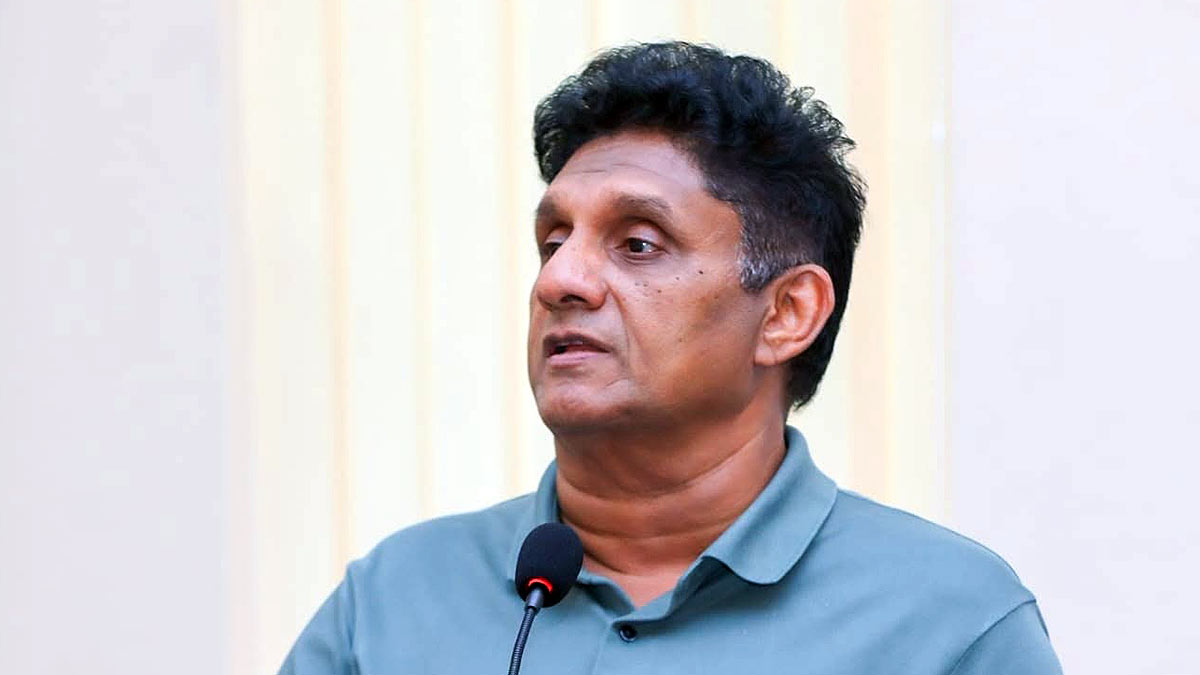
Opposition Leader Sajith Premadasa | FILE PHOTO
Sri Lanka’s Opposition Leader Sajith Premadasa has accused the government of hiding true budget figures and fabricating data to achieve its aims.
Addressing a pre-budget workshop on the 2027 Budget attended by opposition MPs, professors and experts, Premadasa alleged that the government was carrying out a fraudulent programme while placing further pressure on the public.
He said presidential candidate Anura Kumara Dissanayake received 42% of the vote at the presidential election, while the Samagi Jana Balawegaya (SJB) received 32%. He argued that this combined 74% represented a public mandate to pursue a new agreement with the International Monetary Fund (IMF).
According to Premadasa, both the Janatha Vimukthi Peramuna (JVP) and the SJB pledged during the election campaign to seek a new IMF agreement. However, he alleged that the JVP disregarded that mandate after taking power, failed to revise the agreement and subjected the public to hardship. He described this as adopting double standards.
Premadasa said trillionaires and billionaires continued to emerge as winners regardless of which government came to power. He alleged that these groups were unwilling to make sacrifices to address the country’s challenges, while working people’s Employees’ Provident Fund (EPF) and Employees’ Trust Fund (ETF) savings had been “pickpocketed” under IMF conditions.
He claimed that the banking sector suffered no losses during debt restructuring and that those controlling financial resources were protected, while workers’ provident fund savings were plundered through the IMF agreement.
He further accused the current government of going beyond the previous administration’s neoliberal policies while following the same IMF agreement it had previously rejected.
Premadasa said Lazard, the firm that handled Sri Lanka’s debt negotiations, had also handled debt restructuring in Ghana and Zambia. He described Sri Lanka’s macro-linked bonds as a debt arrangement that trapped the country by linking repayments to economic growth.
Under this arrangement, he said, the amount of debt payable would increase as the economy grew.
Referring to a recent meeting between the IMF and the opposition, Premadasa said the opposition had called for an agreement that responded to Sri Lanka’s needs. He stressed that it should benefit the country and prioritise its 22 million people, rather than protect those he described as notorious capitalists.
He also alleged that the government had imposed taxes beyond the level required by the IMF, increasing the primary surplus from 2.3 to 5.4. He said government revenue as a percentage of gross domestic product had risen from 13.9% to 15.4% through taxation.
Premadasa added that the SJB continued to submit proposals to reduce the tax burden.
Turning to poverty figures, he said the government had been questioned about how a person could live on Rs. 17,000. According to him, the government responded that the amount was calculated using a daily requirement of 2,030 kilocalories per person.
However, citing Medical Research Institute (MRI) data, Premadasa said an active man required 3,340 kilocalories a day and an average man required 2,340. He said the daily requirement was 2,680 kilocalories for an active woman and 1,890 for an average woman.
He accused the government of continuing to use false data to determine poverty levels. Citing what he described as World Bank data, he also claimed that nearly 60% of Sri Lanka’s population was poor.
Premadasa questioned whether Aswesuma benefits were reaching the correct recipients. He said that, as with the Samurdhi programme, eligible people were being left without assistance while ineligible people received benefits.
He alleged that Aswesuma recipients had been selected through a chosen group without involving government officials serving at village level. He called for a revised Janasaviya programme to eliminate poverty.
Premadasa also said support was needed to strengthen agriculture, fisheries, workers and intellectuals, among other groups.
He called for a new development bank to support young people and micro, small and medium-scale industrialists, including the proposed project to create one million new entrepreneurs. He said such a bank had yet to be established.
Although funds had been allocated to support micro, small and medium-scale enterprises, he alleged that the money was not reaching entrepreneurs facing difficulties.
Premadasa added that around 250,000 micro, small and medium-scale enterprises had closed during the 2022 economic crisis.