

Sri Lanka President pledges to address workers’ concerns, maintain financial discipline
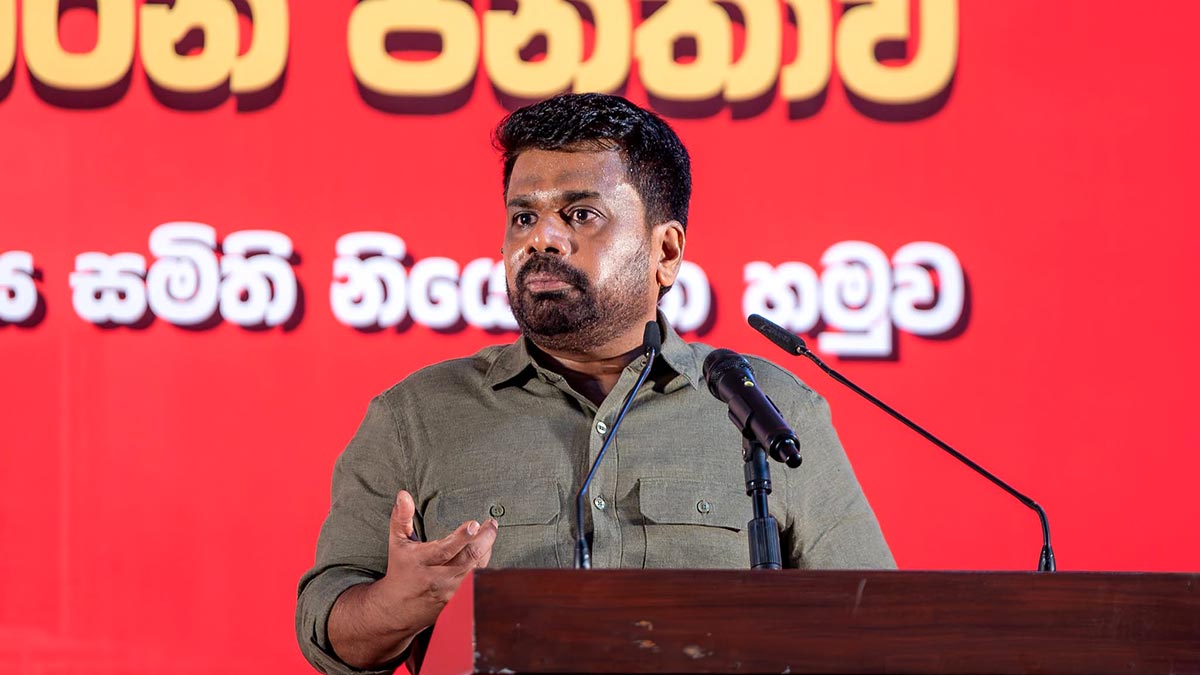
Sri Lanka President Anura Kumara Dissanayake said the government would address workers’ concerns through discussions with trade unions but would not give in to unreasonable demands that could threaten the country’s economic stability.
The President made these remarks at a meeting of trade union representatives held at the Colombo Exhibition and Convention Centre on the evening of November 26, 2026, under the theme “The Budget and Working People”.
He alleged that opposition political groups were behind some protests held in the name of working people. However, he stressed that the government would continue to support workers fighting for just causes while maintaining financial discipline.
The President highlighted the strength of the National Trade Union Centre, noting that thousands of workers had gathered for the meeting despite the decision to organise it being taken only the previous day.
He thanked working people, particularly public servants, for their contribution to bringing the National People’s Power (NPP) government to power. He recalled that postal voting results at the presidential, parliamentary and local government elections had provided the first signs of victory.
President Dissanayake said establishing the rule of law, ending corruption and the waste of public resources, improving Sri Lanka’s international reputation and ensuring financial security for citizens were among the main reasons for forming the NPP government.
He said the government had established the principle that everyone was equal before the law and had taken steps to end corruption and waste involving political authorities in the public sector. Efforts to punish those responsible for corruption would also continue.
The President also highlighted Sri Lanka’s achievements internationally over the past two years, including securing the release of Comrade Anojan.
Financial discipline and economic recovery
President Dissanayake said poor economic policies, corruption, waste and a lack of financial discipline had contributed to Sri Lanka’s economic collapse.
He recalled how foreign loans had been obtained to construct expressways, Mattala Airport and railway lines without generating sufficient foreign currency to repay those loans. Excessive money printing to cover government expenditure had also contributed to rising inflation.
The resulting crisis led to shortages of fuel, cooking gas, milk powder and medicines, disruptions to public transport, the departure of professionals from the country and deaths of people waiting in queues for gas.
He said the government was determined to prevent future generations from experiencing a similar crisis.
The President said financial discipline must begin with the President, followed by the Cabinet of Ministers and Members of Parliament.
He pointed to the removal of vehicle permits for MPs, government residences for ministers and large vehicle convoys as examples of measures taken to reduce unnecessary expenditure. Former official residences are also being converted into courts, commercial facilities and centres for other purposes.
Although economic stability had been restored to some extent, he warned that Sri Lanka had yet to fully overcome its deeper economic problems.
Government revenue and 2027 budget allocations
The President said Sri Lanka recorded its highest government revenue in 23 years in 2025, collecting 114% of its revenue target, compared with collection rates of around 88% to 90% under previous governments.
He acknowledged the contribution of officers of the Inland Revenue Department, the Excise Department and Sri Lanka Customs towards this achievement.
He said government revenue should account for at least 16% of gross domestic product (GDP), with the government aiming to increase it to 20%.
Outlining the financial commitments for 2027, the President said that against expected revenue of Rs. 6,230 billion, the government would have to pay Rs. 2,643 billion in interest and Rs. 2,207 billion in loan repayments, bringing total debt-related payments to Rs. 4,850 billion.
A further Rs. 2,185 billion has been allocated for public servants’ salaries and pensions.
According to the President, these commitments amount to Rs. 7,035 billion, exceeding expected government revenue by Rs. 805 billion.
The government has also allocated Rs. 2,000 billion for capital expenditure and Rs. 1,400 billion for social welfare, while the President said borrowing in 2027 would amount to Rs. 3,800 billion.
He described the capital expenditure allocation as the largest in Sri Lanka’s history and stressed that it was essential for the country’s future development.
President Dissanayake explained that the budget had been carefully prepared by balancing four main areas: debt and interest payments, public servants’ salaries and pensions, social welfare and capital expenditure.
He warned that further increases in salaries and allowances would require additional borrowing or cuts to funding for health, education, infrastructure and other development projects.
He said excessive borrowing could push the country back into a crisis similar to that experienced in 2022 and 2023.
Development of health, education and transport services
The President said the benefits of government expenditure must reach all citizens, including public servants, small and medium-sized business owners and Aswesuma beneficiaries.
Under the 2027 budget, the government plans to provide hospitals across Sri Lanka with modern biomedical equipment within three years.
He said district general hospitals had been brought under the central government, with the aim of ensuring that every district has a hospital equipped with modern technology.
Around 400 hospital ambulances are more than 20 years old, including between 150 and 200 that are more than 25 years old.
The government plans to gradually replace the ageing ambulance fleet and has allocated Rs. 3 billion to purchase new ambulances, in addition to those received through grants and loans.
Steps have also been taken to establish Arogya primary healthcare centres to serve communities of between 5,000 and 10,000 people.
In the education sector, the government plans to complete the provision of fibre-optic connections to all secondary schools in 2026 and extend the programme to primary schools in 2027.
The President said significant funds had also been allocated for education reforms, adding that education had received the largest share of government spending this year.
Regarding transport, he highlighted the need for electric trains, railway lines and expressways. Plans are also underway to introduce 600 air-conditioned buses for long-distance services, additional buses for rural areas and metro buses for cities.
Funds have been allocated in the 2027 budget for drinking water projects where feasibility studies have been completed, as well as for conducting further studies in other suitable areas.
The government is also focusing on rural road development and other infrastructure improvements that directly benefit citizens.
Social welfare, agricultural subsidies and tax relief
President Dissanayake said the government had a responsibility to support elderly people and persons with disabilities who had no one to care for them.
He noted that monthly allowances for persons with disabilities and kidney patients had been increased from Rs. 7,500 to Rs. 12,500.
The government has allocated Rs. 340 billion for the Aswesuma welfare programme in 2027.
The President also said unprecedented funding had been allocated for fertiliser subsidies, including Rs. 50 billion for a programme to provide tea smallholders with a subsidy of Rs. 4,000 per bag of fertiliser twice a year.
Fertiliser subsidies are also being provided for rubber and other crops to increase agricultural production.
He highlighted the removal of taxes on schoolbooks, printed books and exercise books, as well as relief provided to employees through changes to income tax.
The President said the government had raised the monthly tax-free income threshold from Rs. 100,000 to Rs. 162,500.
He recalled that after taking office in September 2024, the government presented a Vote on Account for the first three months of 2025, followed by its first budget.
Government’s commitment to public servants
President Dissanayake stressed that a strong public service was essential for national development and that the government had no intention of weakening it.
He said the government had revoked the circular that removed pension entitlements for public servants recruited after 2016, restoring an important benefit associated with public sector employment.
He also pointed out that the government had increased basic salaries without waiting for workers to launch protests or strikes.
Discussions with trade unions have helped identify several other concerns, including vehicle permits for doctors, which the government is working to resolve.
However, the President stressed that demands exceeding the government’s financial capacity could not be met simply through protests or strikes.
Maintaining government financial reserves
President Dissanayake explained that maintaining cash reserves had enabled the government to control market interest rates by avoiding borrowing at higher rates.
These reserves have also allowed the government to provide relief during natural disasters and other emergencies without cutting existing budget allocations.
He said the government was prepared to meet expenditure arising from the El Niño weather phenomenon without reducing funds already allocated in the budget.
The President recalled that the government had provided subsidies of Rs. 100 per litre of diesel and Rs. 20 per litre of petrol for five months from April.
The subsidies were withdrawn in September following a decline in fuel prices. However, following renewed price increases amid an intensification of the war, the government is currently providing a subsidy of Rs. 70 per litre of diesel, he said.
Responding to questions about why government cash reserves could not be used to increase salaries, the President said maintaining sufficient reserves was part of responsible financial management.
He recalled that the Treasury account had recorded an overdraft of Rs. 700 billion in 2022, whereas the Treasury now held billions of rupees in deposits.
He said these reserves were necessary to manage interest rates, respond to emergencies and begin development projects without delays.
Political groups accused of attempting to create a crisis
President Dissanayake alleged that certain political groups were attempting to destabilise the government by encouraging repeated demands, increasing pressure on the budget and creating an economic crisis.
He said those groups had previously predicted that the government would face a crisis in April and later in November.
However, he stressed that the government would not fall into a trap by agreeing to demands that the Treasury could not afford.
The President also alleged that some opposition parties were operating behind other groups, including Buddhist monks, and presenting political campaigns as efforts to protect the country or religion.
He further said the government had openly explained its economic situation and plans to the International Monetary Fund (IMF) and had received its support.
Unlike previous governments, he said, the current administration had not used the IMF as an excuse to avoid its responsibilities.
The President concluded by calling on working people to cooperate with the government in achieving its economic and national development goals.