

Air India crash: Fuel cutoff led to Boeing 787 Dreamliner disaster
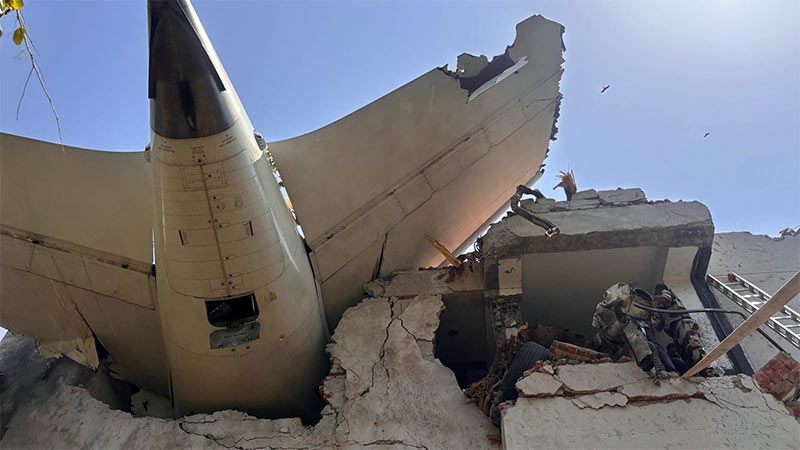
Photo credit: Central Industrial Security Force – CISF
New Delhi: A month after the Air India plane crash in Ahmedabad that killed at least 270 people, a preliminary report into India’s worst aviation accident in decades reveals that the engines’ fuel switches were shifted from ‘RUN’ to ‘CUTOFF’ within seconds of each other after take-off.
The 15-page report was published early Saturday by the Aircraft Accident Investigation Bureau (AAIB), which is probing the crash.
“Why did you cut off?” one of the pilots was heard asking the other in the cockpit voice recording. The other pilot responded that he had not done so.
The CUTOFF transition, which shut off the fuel supply to the plane, could be a key piece in the complex puzzle of what happened on the Boeing 787 Dreamliner on June 12, 2025.
Moments later, the switches for both engines of the London-bound plane were shifted from CUTOFF back to RUN, indicating that the pilots attempted to recover the situation, according to data from the Enhanced Airborne Flight Recorder (EAFR). The 787 Dreamliner, like other commercial aircraft, has sufficient power to complete a takeoff on a single engine, and pilots are well-trained to handle such situations.
“When fuel control switches are moved from CUTOFF to RUN while the aircraft is in flight, each engine’s Full Authority Dual Engine Control (FADEC) automatically manages a relight and thrust recovery sequence of ignition and fuel introduction,” the report stated.
However, the EAFR recording stopped just seconds later. Shortly after, one of the pilots transmitted a MAYDAY alert. Air Traffic Control asked for the call sign but received no response. Moments later, it observed the aircraft crashing just outside the airport boundary.
The aircraft, fully loaded with fuel, rapidly lost altitude and crashed into a hostel for medical students, where it exploded killing all but one of the 242 people on board, as well as around 30 people on the ground. It was airborne for only 32 seconds.
The flight was commanded by Captain Sumeet Sabharwal, a Line Training Captain with 8,200 hours of flying experience, and First Officer Clive Kundar, who had logged 1,100 flying hours. The report confirmed that both pilots were medically fit, well-rested, and adequately experienced.
While there was no immediate evidence of sabotage, the report cited a known Federal Aviation Administration (FAA) advisory regarding a potential fuel switch flaw. The FAA had issued an information bulletin after reports from operators of Model 737 aircraft revealed that fuel control switches were sometimes installed with the locking feature disengaged. “The concern was not considered an unsafe condition,” the report noted.
The report also mentioned that the Ram Air Turbine (RAT) was deployed immediately after takeoff, as seen in airport CCTV footage. The RAT is typically deployed during a dual engine failure or a total electrical or hydraulic systems failure.
“No significant bird activity was observed near the flight path. The aircraft began losing altitude before it crossed the airport perimeter wall,” the report added.
In a related historical note, the report referenced a 1980s incident in which a Delta Air Lines pilot mistakenly cut off fuel to the engines of a Boeing 767. In that case, the aircraft was at a higher altitude, allowing the engines to be restarted and disaster to be averted.
(Courtesy: NDTV)