

Gotabaya rejects abduction allegations in Lalith-Kugan case
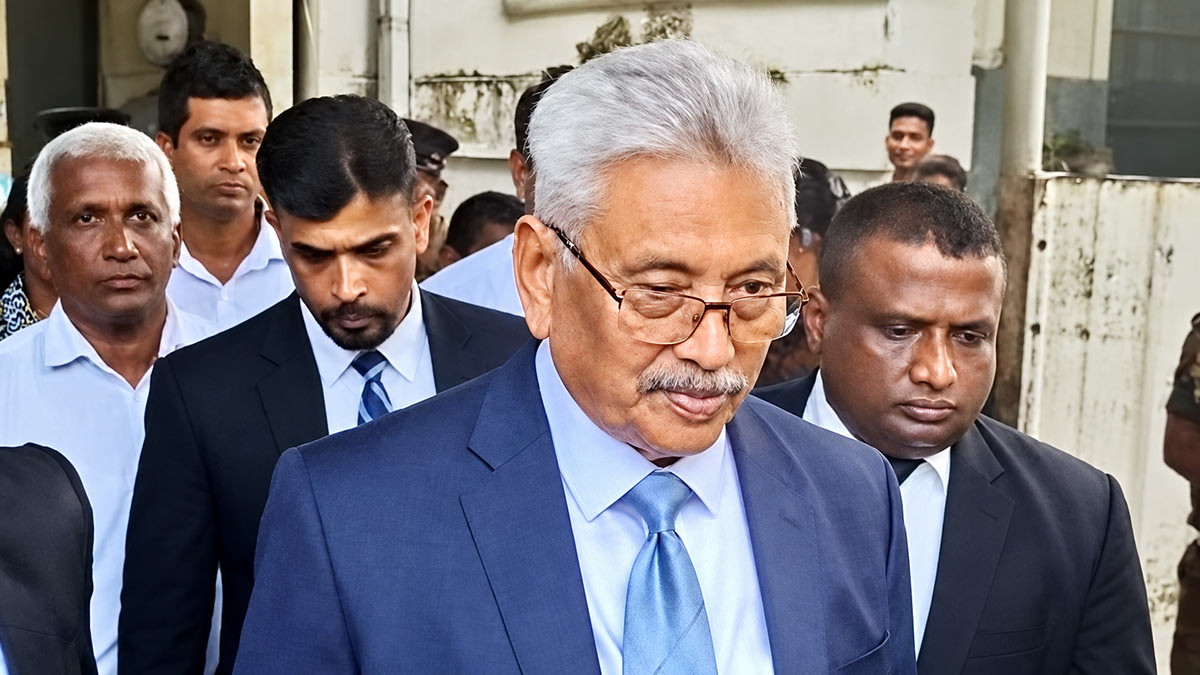
Former Sri Lanka President Gotabaya Rajapaksa | Photo: AI-enhanced for clarity
Former Sri Lankan President Gotabaya Rajapaksa gave evidence online today (September 29) in the Lalith-Kugan disappearance case, saying he could not remember several incidents and rejecting allegations of involvement in abductions and disappearances while serving as Defence Secretary.
Rajapaksa appeared before the Colombo Chief Magistrate’s Court, while his evidence was recorded through a video link for proceedings before the Jaffna Magistrate’s Court.
He arrived at the Colombo court complex at around 1:20 PM, and the recording of evidence began about 10 minutes later.
The case was taken up before Jaffna Magistrate S. Lenin Kumar, with Attorney-at-Law Nuwan Bopage, appearing for the complainants, questioning Rajapaksa.
The proceedings relate to the disappearance of political activists Lalith Kumar Weeraraj and Kugan Muruganandan, who were last seen leaving Kugan’s home in Avarangal, Jaffna, on December 9, 2011.
The two men were reportedly preparing to hold a media briefing on behalf of relatives of missing persons to mark International Human Rights Day when they allegedly disappeared. It has been alleged that they were abducted by a group that arrived in a white van.
Gotabaya Rajapaksa was serving as Sri Lanka’s Defence Secretary at the time.
Then Government Spokesman Keheliya Rambukwella had publicly stated that Lalith and Kugan were alive. During subsequent investigations, Rambukwella reportedly said he had made that statement based on information given to him by then Defence Secretary Gotabaya Rajapaksa.
Notices were subsequently issued to Rajapaksa in March 2019 requiring him to appear before court and give evidence in the case filed by the relatives of Lalith and Kugan.
However, Rajapaksa did not previously appear in person before the Jaffna Magistrate’s Court. He had cited security concerns and later became President of Sri Lanka, serving from 2019 to 2022.
When the case was taken up on February 6, 2026, Rajapaksa’s lawyers requested permission for him to give evidence virtually. The Jaffna Magistrate’s Court granted the request on June 2.
On August 7, the court ordered Rajapaksa to appear before the Colombo Chief Magistrate’s Court on September 29 to give evidence through a video link.
During today’s testimony, Rajapaksa repeatedly said he could not remember several incidents because they had taken place many years ago.
When asked whether the disappearance of civilians could constitute a threat to national security, Rajapaksa said people disappear for various reasons and such incidents are normally investigated by the police.
He said not every disappearance is brought before the Security Council and that information is received only in certain cases, particularly when an incident is considered significant.
Rajapaksa was also questioned about the alleged abduction of former Western Provincial Councillor Sagala Senarathna, but said he could not remember the incident.
A substantial part of the questioning focused on the abduction and assault of journalist Keith Noyahr.
Rajapaksa said he remembered Noyahr and recalled that an incident had taken place, but said he could not remember the details.
When asked whether he remembered reports that Noyahr had gone missing, Rajapaksa said that, as far as he knew, Noyahr had not been missing.
When questioned about allegations that Noyahr had been abducted and tortured, Rajapaksa said he did not know that Noyahr had been abducted, but knew that he had disappeared and was later found.
Asked whether he remembered receiving a telephone call informing him about Noyahr’s disappearance, Rajapaksa said the incident had taken place about 15 years ago and he could not remember who had called him.
When asked whether he had informed then Inspector General of Police Jayantha Wickramaratne, Rajapaksa said that if he had become aware of such an incident, he would have informed the IGP.
He also said he could not remember whether he had informed Major General Hendahewa.
Asked whether he knew that Noyahr had suffered serious injuries and had later been left at another location, Rajapaksa again said he could not remember.
Bopage suggested that Noyahr had been released rather than killed following instructions from Rajapaksa.
Rajapaksa rejected the allegation, saying he knew that an incident had taken place but did not know how it happened or who was responsible.
When Bopage referred to a Criminal Investigation Department report from January 2017 that allegedly stated Rajapaksa had informed a Deputy Inspector General of Police about the matter, Rajapaksa said he could not remember it.
Asked whether he remembered five officers attached to the Army’s Tripoli Platoon being named as suspects in connection with the incident, Rajapaksa said he did not know.
Bopage also suggested that Rajapaksa had directly intervened and issued instructions relating to abductions and disappearances while serving as Defence Secretary.
Rajapaksa rejected the allegation and said he had not been involved in ground operations.
He said his role as Defence Secretary was to communicate government policies to the relevant institutions and that he was not directly involved in field operations.
Rajapaksa also said he had functioned as a civilian and had neither given instructions relating to such incidents nor had the authority to do so.
When asked whether, during his time as Defence Secretary and later as President, he had knowledge of abductions and disappearances in Sri Lanka, Rajapaksa said such allegations had been made for political gain and to damage the country’s reputation.
The court permitted two lawyers to remain with Rajapaksa while he gave evidence through the virtual platform.
Following the conclusion of today’s testimony, Jaffna Magistrate S. Lenin Kumar ordered that the recording of further evidence continue on November 27, 2026.
Speaking after the hearing, Attorney-at-Law Nuwan Bopage said Lalith and Kugan had become symbols of the wider issue of alleged illegal abductions and disappearances in both the North and South of Sri Lanka.
He said the case was intended to show that people would continue seeking justice over disappearances and that those who held positions of power could eventually be required to answer questions before a court.