

Sri Lanka launches driver demerit points pilot and expands traffic fine payments
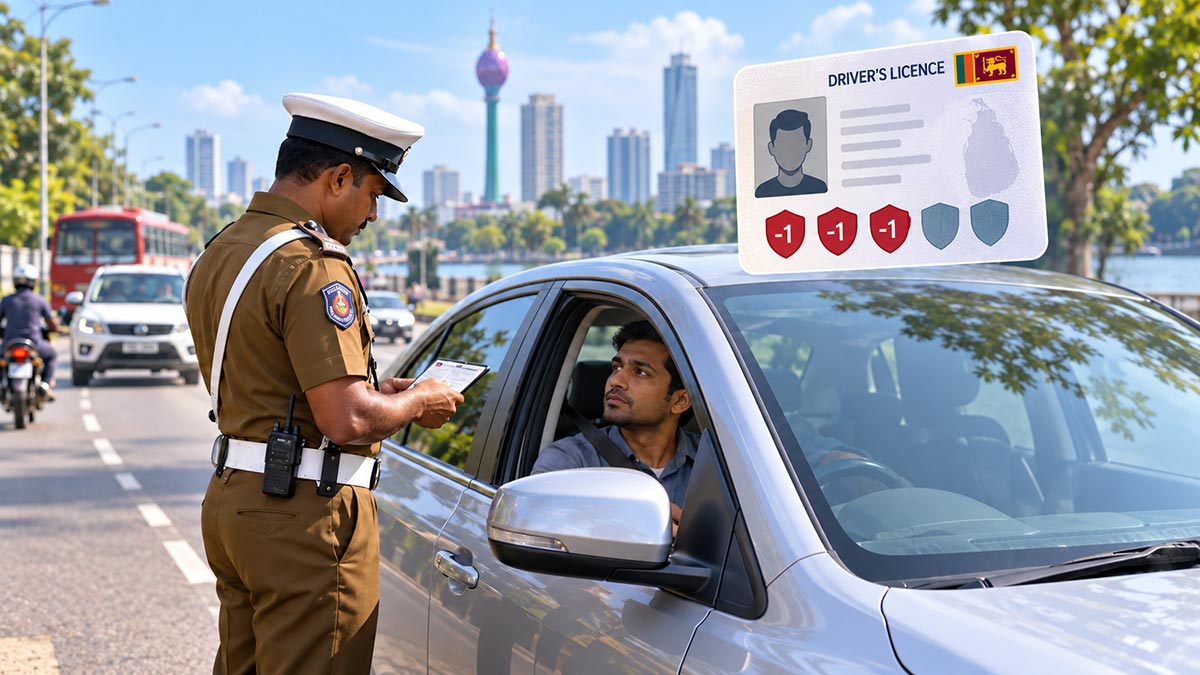
AI-generated image | Image by Onlanka.com
Sri Lanka has launched a six-month pilot project for a driver demerit points system aimed mainly at motorists who repeatedly commit traffic offences, while a new facility to pay traffic fines directly through police stations will be available from October 1, 2026.
Minister of Transport, Highways and Urban Development Bimal Rathnayake announced the measures at a press conference held at the Ministry in Battaramulla today (September 28).
The six-month pilot of the demerit points system is due to run from October 1, 2026 until March 31, 2027, allowing motorists to become familiar with how the system works before it is fully implemented.
Minister Rathnayake said motorists can occasionally make mistakes because of normal human weaknesses, although the law does not provide special exemptions for such offences.
He said the new system is not intended to create serious difficulties for motorists who commit only a small number of offences.
Under the demerit points system, drivers will begin with a certain number of points, while points will be reduced according to the number and seriousness of traffic offences committed.
A motorist who loses only one, two or three points would still be able to continue holding a driving licence, the Minister explained.
However, Rathnayake said there was previously no proper mechanism to specifically identify and deal with motorists who repeatedly commit the same offences and continue to drive recklessly despite receiving traffic fines.
Under the new system, motorists who commit more offences, particularly serious offences, will lose their points faster.
If a driver eventually reaches zero points, the law provides for the temporary suspension of the driving licence for a specified period.
The system also allows authorities to refer motorists to training programmes before reaching the stage of suspending their licences.
Rathnayake stressed that ordinary motorists should not be alarmed by the new system.
“Anyone can make an occasional mistake,” he said, explaining that the system is mainly intended to have an impact on motorists who repeatedly disregard traffic laws, the safety of others and human lives.
He said society should also be given time to adjust whenever a new system is introduced, even when it is introduced with good intentions.
The Minister therefore urged motorists to use the six-month pilot period to become familiar with the system and to make an effort to drive without losing any points.
Meanwhile, Deputy Inspector General of Police (DIG) in charge of the Traffic and Road Safety Range W.P.J. Senadheera said the GovPay traffic fine payment project, which began as a pilot in April 2025 covering 10 police stations, has since expanded across all nine provinces.
He said the project had been introduced to all 607 police stations by January 1 this year, while traffic police officers had been specially trained to operate the system. Official government documents also identify 607 police stations operating across the country.
More than 5,000 mobile phones have also been provided through LankaPay to help traffic police officers operate the GovPay system, according to the DIG.
Senadheera said more than 20% of traffic fines are currently being paid through GovPay, which he described as significant progress.
He said the Police consider GovPay one of the most useful initiatives introduced under the government’s programme to digitise state institutions, particularly because of the convenience it provides to motorists.
A further facility will be introduced from October 1 with the involvement of the Transport Ministry, Ministry of Digital Economy, Ministry of Justice and the Inspector General of Police.
Under the new arrangement, motorists who are unable to make an online payment will be able to visit a police station and pay their traffic fine using mobile phones provided to the Police.
Senadheera said this would remove the need for motorists to travel from place to place to settle fines and collect their driving licences.
As all 607 police stations operate 24 hours a day, motorists will be able to visit a station at night, early in the morning or even on a public holiday, pay the fine and obtain their driving licence, he said.
The DIG said he expects almost all traffic fine payments could eventually be processed through the GovPay system once the police-station payment facility becomes available.
During the demerit points pilot period, motorists will also be able to monitor how their points would be reduced for traffic offences.
Senadheera said Police analysis shows that more than 80% of motorists are law-abiding and disciplined drivers, while only a relatively small group repeatedly commits traffic offences.
He said the main purpose of the demerit points system is to encourage greater self-control and discipline among motorists, reduce traffic offences and ultimately cut the number of fatal and serious road accidents.
The Transport Minister and Inspector General of Police expect the system to improve driver discipline and contribute to reducing road accidents, he added.
Senadheera said allowing motorists to settle fines directly through police stations from October 1 would also save considerable time and effort for the public.
The Police believe those savings could contribute to greater productivity and provide a wider benefit to the country’s economy, he said.