

59th National New Rice Festival held at Jaya Sri Maha Bodhi under President’s patronage
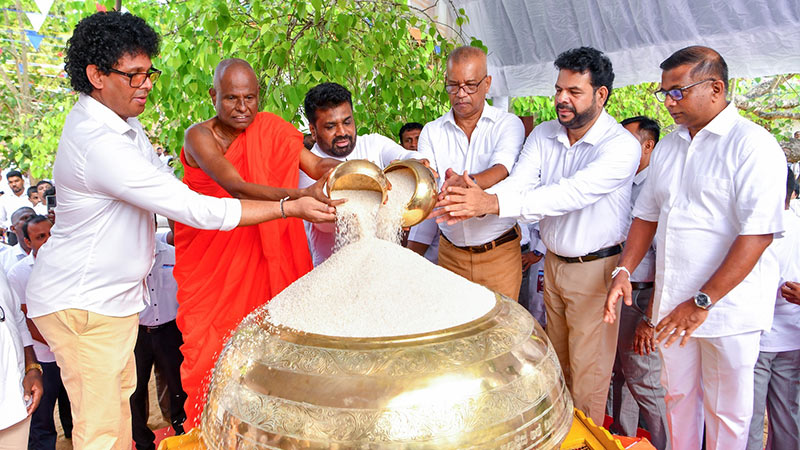
The 59th National New Rice Festival was held at the sacred Jaya Sri Maha Bodhi in Anuradhapura yesterday morning (April 9) under the patronage of President Anura Kumara Dissanayake, bringing together farmers, religious leaders and state officials for the country’s annual offering of newly harvested Maha season rice.
Held under the theme, “In unison, let us cultivate the land, to build a self-sufficient nation,” the ceremony was organised on the guidance of Atamasthana Chief Prelate Venerable Pallegama Hemarathana Nayaka Thera, jointly by the Ministry of Agriculture and the Department of Agrarian Services.
Farmers from across Sri Lanka took part in the long-standing tradition, where newly harvested rice is offered to the sacred Jaya Sri Maha Bodhi. As part of the customary rituals, blessings were sought for timely rainfall, fertile fields, agricultural self-sufficiency and a stronger national economy.
President Dissanayake first paid homage to the Jaya Sri Maha Bodhi and received blessings. During the ceremony, Indigenous community leader Uruwarige Wannila Aththo presented a vessel of pure honey to the President for the traditional offering, while a vessel of ghee brought from the historic Saman Devalaya in Sabaragamuwa was also handed over for the rituals.
A commemorative volume marking the 59th National New Rice Festival was presented to the President. Farmer leaders who contributed to the advancement of agriculture were also honoured. Awards were presented to Kingsley Kumara for minor irrigation, W. Sumith Lakshman Kumara for major irrigation and H. M. Upali Dharmarathne for the Mahaweli scheme. The President also joined the distribution of paddy seeds to farmers at the provincial level.
Addressing the gathering, President Dissanayake said Sri Lanka would not face a food shortage despite global crises because of the dedication of the farming community. He expressed appreciation for farmers who work day and night through difficult conditions to ensure food security.
The President said the Government has a broad plan to improve the living standards of farmers and strengthen the agricultural sector. He said policies have been prepared focusing on seven key areas, including restoring minor and medium-scale tank systems, ensuring water for cultivation, supplying agricultural inputs at fair prices, introducing modern technology, reducing post-harvest losses, improving storage and packaging, and creating better market systems to ensure fair prices for produce.
He stressed that agriculture is deeply tied to Sri Lanka’s identity, economy and culture, and said the New Rice Festival reflects that connection. He said the country’s development path has always been linked to farming, and that many customs, traditions and religious practices have grown around cultivation, harvesting and thanksgiving.
The President also highlighted major land issues faced by farmers and said a programme has already been launched under the Ministry of Agriculture to provide permanent land titles. He said secure land ownership is essential to improving the lives of rural families.
He placed special emphasis on irrigation, noting that Sri Lanka’s ancient civilisation was built around tanks and reservoirs. He said nearly 32,000 tanks once existed in the country, but only around 14,000 remain today, making their protection a national responsibility. He said the Government has taken a firm decision to reorganise and protect the small and medium-scale tank system for future generations.
President Dissanayake also referred to major irrigation projects, saying the North Central Maha Ela Project must be completed to help supply water to the North Central Province. He said the canal from Eruwewa to Mahakanadarawa has already been cut and that water is expected to be supplied to the Mahakanadarawa tank within the Government’s first term. He added that funds have also been allocated this year to restart and complete the stalled Malwathu Oya project.
On agricultural inputs, the President said the Government has decided to supply urea for paddy cultivation at a maximum price of Rs. 10,200, despite rising global prices. He also said the fertiliser subsidy for paddy farmers will be raised to between Rs. 25,000 and Rs. 30,000, while the subsidy for small-scale vegetable cultivation will be increased from Rs. 15,000 to Rs. 18,000.
He said Sri Lanka must also adopt modern technology in farming, especially at a time when the sector faces labour shortages. He pointed to the need for new methods in land preparation, irrigation, fertiliser application and harvesting in order to improve productivity and efficiency.
The President further said reducing post-harvest losses remains a priority, and noted that a special institution has been established in Anuradhapura for research and action in that area. He said more support would be given for research and innovation to improve agriculture.
He also acknowledged the long-standing problem of farmers not receiving fair prices for their harvests, saying the issue cannot be solved overnight but that the Government has a clear plan to address it.
President Dissanayake said improving the lives of farmers goes beyond cultivation and includes housing, stable income, mental well-being, education for children and access to healthcare. He called on the public to unite in respecting farmers and supporting efforts to improve their lives.
A large gathering attended the event, including Atamasthanadhipathi and Chief Sanghanayake of Nuwara Kalaviya Venerable Pallegama Hemarathana Nayaka Thero, Ruwanweli Chaityaramayadhipathi and Chancellor of Rajarata University Venerable Eethalawetunuwewe Gnanathilaka Thero, Chief Judicial Sanghanayake of Lankaramadhipathi of the North Central Province Venerable Ralapanawe Dhammajothi Thero, members of the Maha Sangha, Minister of Agriculture, Livestock, Land and Irrigation K.D. Lal Kantha, Minister of Trade, Commerce, Food Security and Cooperative Development Wasantha Samarasinghe, North Central Province Governor Wasantha Kumara Wimalasiri, Deputy Minister of Agriculture and Livestock Namal Karunaratne, ministry officials and a large number of farmers.