

Sri Lanka launches free LankaQR payments up to Rs. 5,000
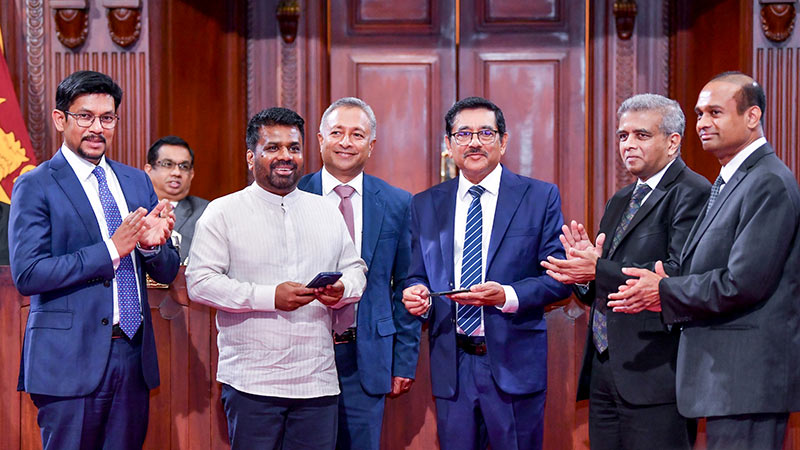
LankaQR transactions up to Rs. 5,000 are now free of merchant service fees, as Sri Lanka President Anura Kumara Dissanayake today (April 6) launched Sri Lanka’s National QR Payment Adoption Programme to speed up the shift towards a cash-lite digital economy.
President Anura Kumara Dissanayake launched the “National QR Payment Adoption Programme” this morning (April 6) at the Presidential Secretariat in Colombo, describing digitalisation as a key government priority to build a transparent, efficient, reliable and secure transaction system.
The new programme aims to reduce the country’s reliance on coins and currency notes and move Sri Lanka towards a cash-lite economy. Under the initiative, financial institutions have removed the Merchant Discount Rate (MDR) charged from merchants on all LankaQR transactions up to Rs. 5,000 with effect from today.
Another key feature introduced under the programme is person-to-person (P2P) QR transactions, allowing people to carry out payments easily at any time and from any location. Central Bank Governor Dr. Nandalal Weerasinghe said this is one of the most important changes in the latest push, noting that individuals can now simply print and carry a QR code to receive or make payments without cash.
The programme is being implemented with the support of the Ministry of Digital Economy, the Central Bank of Sri Lanka, GovTech, LankaPay and financial institutions. It is built on four main pillars: removing barriers to transactions, encouraging the public through incentives and benefits, introducing new technologies and carrying out nationwide awareness programmes.
Addressing the gathering, President Dissanayake said the government sees digitalisation of transactions as essential for improving data collection on economic activity and social conditions. He said this would help the state identify targeted groups more accurately when granting subsidies and support schemes.
Explaining the need for better data, the President referred to the impact of rising fuel prices linked to the Middle East crisis. He said the government must balance the effect of higher prices on the national economy with the need to protect institutions in the fuel sector, including the Ceylon Petroleum Corporation (CEYPETCO).
He said the government had decided to provide a subsidy of up to Rs. 100 on diesel after considering market price fluctuations, but pointed out that without proper data it is difficult to ensure such subsidies reach the people who need them most.
He noted that if a person in a rural area buys five litres of diesel, they receive a subsidy of Rs. 500, while someone filling a large vehicle with 100 litres receives Rs. 10,000 as a government subsidy. He said such examples show why more attention must be paid to collecting transaction data, adding that transactions can reflect an individual’s economic status and could be used as a criterion when granting subsidies.
The President said bringing transactions in all sectors into digital systems would allow subsidies to be directed to the intended beneficiaries while also helping the country gradually integrate the informal economy into the formal economy.
He added that the government’s digitalisation programme is one of its priority initiatives and forms part of a wider target to build a digital economy worth US$ 15 billion.
He said the aim is not only to create a US$ 15 billion digital sector, but also to generate wider economic growth through the efficiency created by using digital technology in sectors such as agriculture and small and medium-scale enterprises.
President Dissanayake also said that although Sri Lanka has a society strongly linked to transactions and banking activity, the country has not yet managed to shift that relationship from traditional paper-based systems to modern digital platforms in a sufficiently broad and structured way.
He stressed that extensive media publicity and public awareness programmes are needed to help people adopt the new payment methods.
He also highlighted the importance of linking digital payments with local cultural practices. He said Sri Lankan society includes many everyday and social transactions, such as money given to schoolchildren or during New Year customs, and these too must be brought into digital systems if QR payments are to become part of daily life.
He suggested that promoting New Year transactions through QR-based payments could become an important turning point in changing public behaviour.
Calling on banks and financial institutions to support the programme, the President said society is ready to accept new developments, but only if they are attractive and convenient. He said the government, banks and financial institutions must take the first steps to help the programme spread rapidly across society.
Deputy Minister of Digital Economy Eng. Eranga Weeraratne said Sri Lanka currently has currency notes and coins worth Rs. 1.48 trillion in circulation and that the country remains heavily dependent on physical cash.
He said about 89% of people over the age of 18 already have bank accounts and that ATMs are available across the country, showing that the banking system has already achieved a high level of digitalisation.
However, he said the use of QR payments remains very low. According to him, 99% of retail transactions in Sri Lanka are still made in cash, while only around 400,000 people used QR-based payments in the final quarter of last year. He said this is why the government is now moving ahead with the National QR Adoption Programme.
He added that once people register using their bank accounts, they will be able to make QR payments even for very small purchases, including buying a king coconut from a roadside vendor.
He said a lottery-based incentive scheme is also being planned to encourage both merchants and the public to adopt the system quickly, along with a large-scale nationwide awareness campaign.
Central Bank Governor Dr. Nandalal Weerasinghe said the authorities had examined why the QR system had not been widely adopted in the past and introduced two special measures in response.
He said the first was free transactions below Rs. 5,000, while the second was the launch of P2P QR transactions. He also thanked the Sri Lanka Banks’ Association and LankaPay for agreeing to bear a certain level of cost to support the initiative.
Chief Advisor to the President on Digital Economy Dr. Hans Wijayasuriya also addressed the event.
The event was attended by Secretary to the President Dr. Nandika Sanath Kumanayake, ministry secretaries and government officials, as well as chairpersons and chief executive officers of banks and financial institutions.