

Sri Lanka launches national ‘Rebuilding Sri Lanka’ programme
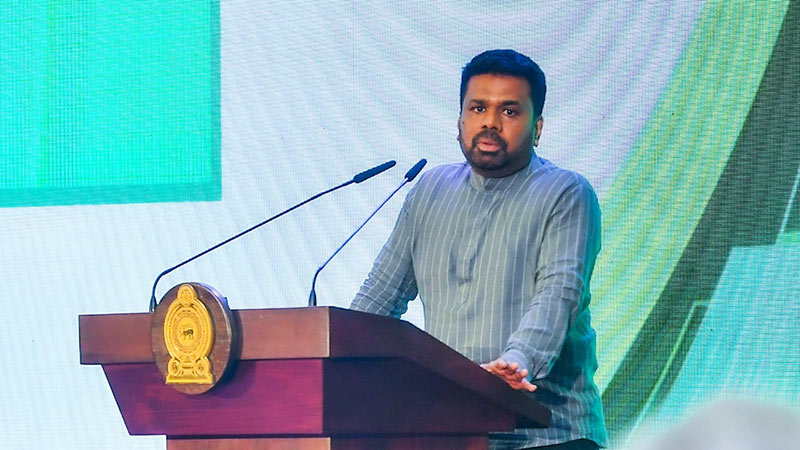
Sri Lanka President Anura Kumara Dissanayake said the country will not use disasters or crises as excuses to abandon national development plans, stressing that Sri Lanka will rise again and rebuild better than before.
The President made these remarks while addressing the inaugural ceremony of the “Rebuilding Sri Lanka” National Programme held this morning (January 13) at the Lotus Hall of the Bandaranaike Memorial International Conference Hall in Colombo.
He said the government would continue its planned reforms and development agenda despite the devastation caused by Cyclone Ditwah, which affected all parts of the country, resulting in loss of life and severe damage to public and private property.
The “Rebuilding Sri Lanka” programme was launched to create a highly coordinated national recovery mechanism to handle post disaster rehabilitation and reconstruction efforts.
A dedicated website, www.rebuildingsrilanka.gov.lk, was also launched at the event. The website allows individuals and organisations to make financial and material donations, donate land and support specific reconstruction projects. All donation details will be publicly displayed to ensure transparency and accountability. District wise data on the extent of damage caused by the disaster is also available on the site. Details of land donated by several individuals have already been uploaded.
President Dissanayake noted that while natural disasters affect everyone, more than 80 percent of those impacted by Cyclone Ditwah are economically disadvantaged people due to long standing social inequalities. He said the government decided to provide the highest compensation in Sri Lanka’s history to improve their living conditions.
He stated that around 700,000 families, representing about 2.4 million people, were affected by the disaster. About 6,000 houses were completely destroyed, while approximately 110,000 houses suffered partial damage. In addition, nearly 10,000 houses were identified as uninhabitable due to high risk conditions, bringing the total number of new houses required to over 20,000.
The President said the 2026 Budget had already planned the construction of 31,000 houses. An allocation of Rs. 5,000 million was retained to build 2,500 houses for families still living in camps in the North, even years after the end of the war. A separate housing programme for economically distressed families plans to construct 10,000 houses this year with an allocation of Rs. 10,000 million. Altogether, more than 50,000 houses will be built in 2026.
He announced that Rs. 5 million will be provided for each newly constructed house, while Rs. 500,000 will be granted for partially damaged houses without requiring assessments. Additional support will be given to restart agriculture, animal husbandry and industries.
The President said the government passed the same Budget prepared before the cyclone, without revising it, to protect long term development goals. A supplementary estimate of Rs. 500 billion has been presented solely to meet disaster related expenses.
With World Bank assistance, a preliminary estimate of USD 4.1 billion has been prepared for recovery efforts, while projects worth around USD 2.8 billion have already been identified.
President Dissanayake also stressed the importance of restoring the Central Highlands, warning that environmental degradation has increased disaster risks. He said long term restoration plans are being implemented to protect the region and the 103 rivers originating from it.
Reaffirming his commitment to accountability, the President said responsibility would be taken for every rupee received, ensuring strict financial discipline and transparency throughout the rebuilding process.
The event was attended by several Cabinet Ministers, Deputy Ministers, Members of Parliament, Secretary to the President Dr Nandika Sanath Kumanayake, senior state officials, foreign ambassadors, representatives of international organisations including the United Nations, private sector representatives, scholars, artists and members of the security forces.