

Sri Lanka President rejects racism as a basis for any political agenda
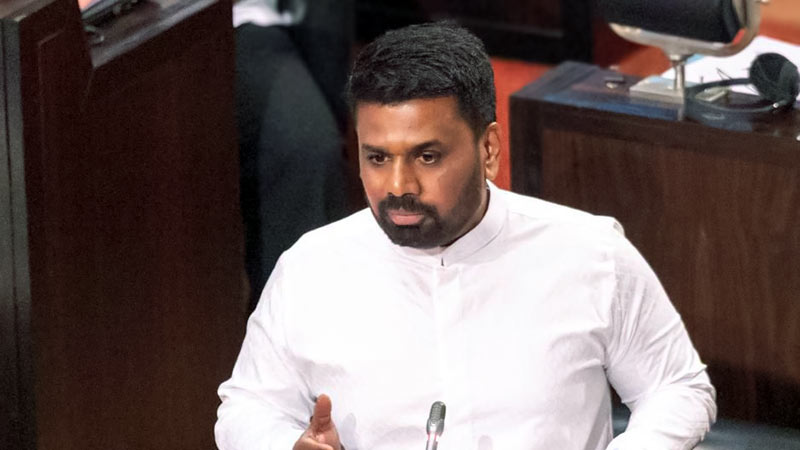
Sri Lanka President Anura Kumara Dissanayake emphasised that the government is committed to the pursuit of truth as well as the pursuit of justice, and that the government needs a voice for justice.
The President made this remark yesterday (November 18) in the Parliament of Sri Lanka while participating in the debate on the expenditure heads of the Ministry of Defence and the Ministry of Public Security.
Following is the full speech delivered by President Dissanayake:
What is happening now is arson carried out by opportunistic groups. However, we will not allow room for racism or communalism under any circumstances. It is not only I who say this. The Buddhist populace of this country will not allow it. The Hindu, Muslim and Catholic people of this country will not allow it. Therefore, if anyone attempts to revive the old racist dramas in this country, they will remain only in history. They do not belong to the present or the future. Everyone must understand that the future political agenda of our country, and indeed the current political agenda, will not be written on the basis of racism.
During this debate on the expenditure heads of the Ministry of Defence and the Ministry of Public Security, given the significant involvement of these two Ministries in many national responsibilities, I intend to present a few points.
In particular, we know that racist tendencies emerge in various forms at different times in our country. In the past, governments fell due to anti corruption forces. However, such an accusation cannot be levelled against our government. Similarly, the government that was in power until 1994 collapsed due to issues relating to democracy. Our government cannot be accused in that regard either. In more recent times, governments collapsed due to economic problems, and even in that regard no accusation can be levelled against this government. Therefore, no constructive slogan remains for these defeated political forces. As a result, their objective has become the creation of racist opportunities.
Therefore, attention must be paid to the Police, the law and the social unrest that could arise through the enforcement of the law. In some instances, the political activities surrounding such issues must also be considered. I have instructed the Secretary to the Ministry of Public Security to provide a report regarding the issue involving the Buddha statue in Trincomalee. The note on the transfer of the Buddha statue to the police station clearly states that it was brought there for security. However, if the statue remains at the police station, the next conflict will be between the Police and the racist groups. Therefore, the statue has been returned to its location and necessary security has been provided.
The issue is now before the judiciary. Prior to this, a discussion was held at the District Secretariat yesterday (November 17). A permit for the relevant structure was granted in 2014. Although it is now being referred to as a temple or Viharaya, it has not been functioning as a temple in recent times and has instead been used as a canteen.
The Coast Conservation Department had determined that there were illegal constructions at the canteen and issued an order to remove them. An appeal against the order was submitted to the Ministry of Environment. The Secretary to the Ministry of Environment maintained that the structures must be removed. Following this, during a discussion between the Police and the Urban Development Authority, the Venerable Monks requested one more week, saying they intended to appeal to the Court of Appeal. That period ended on the 14th, and the incident took place on the 16th. It appears there is another story behind this issue, beyond merely establishing a religious place. Although the Monk had ownership of the land, there was no designated site for religious observance. That is the factual situation.
In the discussion held at the District Secretariat after the incident, it was agreed that a proper survey would be carried out to allocate the land belonging to the Coast Conservation Department and separately designate the land belonging to the temple. However, the existing court order, along with the previous case, states that no new construction should be carried out and that existing structures should not be removed. The relevant work can be carried out after a judgement is issued and after the land belonging to the temple is demarcated. Therefore, this issue has now been resolved.
What is happening now is arson carried out by opportunistic groups. However, we will not allow room for racism under any circumstances. It is not only I who say this. The Buddhist populace will not allow it. The Hindu, Muslim and Catholic people of this country will not allow it. If anyone attempts to revive the old racist dramas, they will remain only in history. They do not belong to the present or the future. Everyone must understand that the political agenda of our country, both present and future, will not be built on racism.
Furthermore, as the Ministry of Defence, we understand that any armed force prepares based on the nature of the threat it anticipates. We currently expect that large scale internal civil conflict will not recur in Sri Lanka for a long time. Similarly, there is no likelihood of us being invaded by any Western nation in the near future. Therefore, we are structuring our military to confront threats that may arise in the technological domain, cyberspace and from modern technological tools. We also have a responsibility to safeguard our maritime borders. Likewise, we have identified threats in our airspace. We prepare our military based on these threat profiles. Building a military equipped with modern technological tools is the policy of our government.
In recent times, we have received considerable international support for the restructuring of our military. We have received approximately 70 jeeps from India. A proposal has also been received for an academy required to develop our military into a highly proficient force, and support has been extended for that initiative.
The United States of America has agreed to provide 10 TH 57 helicopters as aid in 2026. Similarly, the United States of America and Australia have agreed to provide two C 130 aircraft as aid in 2026 and 2027. We have also received a Beechcraft KA 360 and two Beechcraft KK 350s as aid from the United States of America and Australia. Our Air Force helicopter fleet has been significantly depleted, and now we will be receiving 10 new helicopters. Tenders have been called and arrangements made for the refurbishment of the existing helicopters. We have therefore established a modern and efficient military. We believe this is our responsibility.
I would also like to address the issue of reconciliation. This is currently being implemented under four interconnected stages. The first is the pursuit of truth. We have a responsibility to investigate what exactly happened. We agree to establish a mechanism for truth seeking.
Next is the pursuit of justice. We will not hesitate to deliver justice for crimes. In pursuing justice, there is a risk that old discussions such as the claim of hunting down war heroes may resurface. Certain Naval officers have been accused of abducting and murdering 11 students in our country. The Navy played a significant role in ending the war. However, the allegation regarding the disappearance of the 11 children has no connection to war operations.
As a nation, should we sacrifice the entire Navy for this accusation, or should we identify and punish the rightful culprits? To protect the honour of the Navy and to deliver justice for the disappearance of those 11 people, investigations are being conducted and the guilty will be brought before the law. I do not believe any Naval officer will oppose this. Investigations have been conducted. Some may ask about the delay. The nature of the legal process contributes to delay. Some individuals obtain Writs to prevent arrest. However, we allow such processes. We provide legal protection and conduct proper investigations to ensure that the guilty are punished. This must never be seen as a witch hunt.
Likewise, military intelligence units have been accused in relation to certain murders. Should we allow those accusations to remain unaddressed, staining the military intelligence unit, or should we investigate them and punish those who are guilty? There are mechanisms for the operations of a country.
There are also incidents that occur outside standard procedures. They must be properly documented in the interest of state security. For that, we must maintain a strong intelligence unit. However, the public must have confidence in the reputation of that unit. In many incidents in the recent past, several individuals have been accused. It is our responsibility to ensure that these institutions become clean and reputable in the eyes of the international community, the general public and their own staff. We have initiated the investigation into the Lasantha murder.
If our government had been in power when this murder occurred, the suspects would already be in custody. The problem is that this murder is being investigated after 17 years. It is not easy to investigate after such a long time, but we are pursuing the case. It is the responsibility of the Jathika Jana Balawegaya government to safeguard the discipline and reputation of these institutions. Take the Thajudeen murder as an example. Investigations have begun and some Naval officers need to be questioned. Should we not pursue the culprits? I recently asked investigating officers whether this was a natural accident or a murder. Both the investigators and the court confirmed it was a murder. Therefore, it was not a natural death. While investigating such cases, they should not be labelled as war hero hunts.
We must investigate the Ekneligoda murder and the Easter Attacks. This process has begun and investigations are underway. Facts must be established in a court of law.
Mere statements are not enough to file a case. Investigations are necessary because evidence must be produced in court. Telephone analysis and establishing their connections are required. The mastermind we are looking for is not the person who carried out the attack. The Easter Attacks should have been investigated when the events were fresh, but the issue could not be resolved. Later, power shifted to groups suspected of involvement. Once in power, they suppressed a great deal of evidence. Pages were torn from books.
In recent years, suspects were usually arrested within three days of a murder. However, when power went to them, for the first time in Sri Lanka, travel bans were issued to about 500 officers of the Criminal Investigation Department. Some CID officers were removed. Shani Abeysekara was imprisoned. These investigative bodies were dismantled and officers were transferred. It is difficult to investigate after five years. However, I have confidence in our investigative teams. They will conduct proper investigations and bring the guilty before the law.
Delivering justice must never be seen as a witch hunt. These investigations are being conducted with fairness. No one is being influenced. We are carrying out the pursuit of truth and the pursuit of justice correctly. Recently, two burial sites were discovered. We did not appoint Commissions but appointed proper investigative teams under court orders. No one can say these investigations are wrong. We need a voice for justice.
The third stage is compensation. Where damage has occurred, compensation is being provided. Recently, our intelligence services recovered a stockpile of gold and handed it over to us. We attempted to find the owners, but they cannot be traced. We have decided to convert it into money and distribute the funds among the people of the area. We must ensure fairness.
We must also take action to prevent such situations from recurring. Only we can create an environment that prevents their recurrence, and we will do so.
We will not allow racial conflicts to arise again in our country. We recognise the people’s right to engage in politics. Our country has long been plagued by ethnic conflicts. Such conflicts cannot be extinguished merely by pouring water on them. Hatred and suspicion have existed for a long time. In this context, we will build national unity and reconciliation without allowing even the smallest mistake to occur. We will hold a Sri Lanka Day for ethnic harmony this December. We intend to meet with politicians representing all ethnicities to discuss this programme. Someone said to be careful when holding such a day. I say to be careful when coming. Is there no need for cultural exchange between the people of the North and the South?
Our military and we have carried out a great deal of work to build national unity in this country. The Ministry of Public Security and the Police Department are carrying out their duties effectively. Now they are speaking of bringing a No Confidence Motion against the Secretary to the Ministry of Public Security. Why is he being made an accused?
The Secretary works day and night to suppress drugs and the underworld. He is a friend of the people. Whose enemy is he? Not the public. He is the enemy of the criminals.
I also observed the heavy attacks being directed at the Secretary of the Ministry of Public Security, Mr. Ravi Seneviratne. These attacks are wrong. He is an official respected by all. He acts courageously against drug related crimes and other serious crimes. In such a situation, some want to bring down such officials. Attacking Mr. Seneviratne means siding with criminals, with the corrupt, with organised criminal groups. That is the truth. How can such officials be enemies?
Similarly, how can Shani Abeysekara be an enemy? Nearly all of the investigations conducted by him resulted in convictions in court. Many resulted in the death penalty. In the Udatalawinna case, five were sentenced to death. In the Rajagiriya Royal Park case, the accused was sentenced to death. Although Maithri later released him, the sentence was delivered. Shani conducted major investigations of this nature. We need such experienced officers to train new recruits. These are people who were never subservient.
Did these officers, who established law and order in this country and risked their lives, become your accused for what they did for the country? We will protect such people. Should we not do so? Why is he being accused today? Because when investigations move toward criminals, that is when Shani becomes a target.
Next, Ranga Disanayake of the Bribery Commission was also widely accused. We need a courageous public service. These officials are working towards that. It is the responsibility of Parliament to protect such officials. The national responsibility lies there.
However, what is happening now? If officials work bravely, with discipline and without corruption, attempts are made to bring those officials down. Parliament must adopt a collective approach to protect such skilled and brave officers. I have told them to do their work properly. We will stand for their protection during their service and even after they retire.
Next, let me tell you who is being accused. Our Inspector General of Police, who is currently partly accused. Next, Mr. Karawita of the Criminal Investigation Department. While they pursue the frauds, corruption and crimes committed by some, the corrupt and criminals begin targeting them. I urge you to stop this. Do not engage in it.
Next, we are aware of the problem of the drug menace. In the late seventies and early eighties, there were usually village thugs and small drug dealers who brewed illegal alcohol and sold cannabis. When such a thug went to prison, the village was free. Society showed them disgust. If such a person came down one side of the road, others moved to the opposite side. They were not invited to weddings or functions. Society ostracised them.
However, these thugs later turned to politics. In particular, the government that came to power in 1977 ensured every Member of Parliament had a thug near him. That was when they received political protection. Then, they were no longer the small time thugs from the village. They became influential and arrogant with political patronage. They did not initially enter the drug trade. They entered contract work. Soththi Upali seized earth at Gam Udawa events. Beddagana Sanjeewa took small contracts. They earned money.
Then, a large global drug distribution network was created. These individuals entered the drug trade. Now they have political power. They engage in the drug trade and generate huge sums of money. This enabled them to buy influence in the state mechanism. Money began to bring social respect. In village functions, the person who illegally amassed wealth became the chief guest. Instead of the social ostracism they once faced, they gained social protection. Through wealth, they entered the state mechanism.
They began bribing Police officers, officers of the Department of Motor Traffic, Immigration and Customs. The state mechanism became integrated into this. They invested money. A business network built on illegal wealth was formed. Some businessmen even invested money in media.
This has grown from a mere thug into a network consisting of political authority, drug traffickers, armed criminals, corrupt state officials and sections of the media. Our intelligence services will soon reveal connections with media networks.
This is no longer a drug seller or an ordinary thug. It is an organised entity. Some of these organised operations have international links. We have seen this internationally. After the President of Haiti was assassinated, it was revealed that it was linked to anti drug efforts. A popular presidential candidate in Mexico was assassinated. After some drug traffickers were arrested, demonstrations were created. Internationally or domestically, this has become something else. It is no longer the village thug. Organised criminal gangs have become a ring of thieves.
A large number of arrests are taking place, but the operation continues to some extent because the network operated with the blessing of the government. It was functional. The network was needed by the state mechanism to maintain power in villages, frighten people and ensure security. Some politicians used underworld leaders for protection.
Similarly, when our colleague Nalintha Jayatissa held a meeting in Katuwana, shots were fired, killing two people. Who did it? Julampitiye Amare. Is it untrue that Beddagana Sanjeewa and Soththi Upali aimed for ministerial positions? They created this unnecessary power. Along with it came drugs, narcotics, anti social activities and armed criminal gangs. This is the current situation. We must defeat it. Do not doubt that.
The entire society in the North, East and South has been affected. That is why we needed a national operation. This is not a government process. Regardless of who governs, we must eliminate drugs and the associated armed criminal gangs. The Ministry of Public Security and all associated institutions must work towards this.
The public is giving strong support today. However, opposition politicians are working against it. We are confident that the public will not allow any political party that opposes this process to succeed. The political mechanism that blessed and sponsored these elements has been defeated by the people. Our intention is not to allow such political movements to seize power again for destructive ends.
Therefore, we analyse where the danger lies. We have an official mechanism that prepares plans based on these analyses. We have confidence in it. Today, the Defence Secretary can be contacted at any time. In the past, Defence Secretaries expected ministers to kneel before them. Today, anyone from the opposition or the government can speak to the Defence Secretary at any time. The Inspector General of Police is the same. The officials of the Ministry of Public Security and the Ministry of State Defence are working tirelessly to establish the rule of law and ensure public security.
Finally, I extend my gratitude to all the officials, including the Secretaries of the two Ministries, the Commanders of the three Armed Forces and the Inspector General of Police.
We appreciate their contributions. They risk their lives more than any other group. They work with the constant uncertainty of whether they will be victimised or whether they will be able to enjoy their retirement in this country. They work in extremely challenging circumstances. As a government, we assure them that we will protect them. Even if we are not in government, we will protect them. I thank all of you once again for your commitment to ensuring state security and public security in our country, and for your efforts to eliminate the underworld, crime and corruption, in order to build a better state.