

Sri Lanka to review prison rules for Buddhist monks
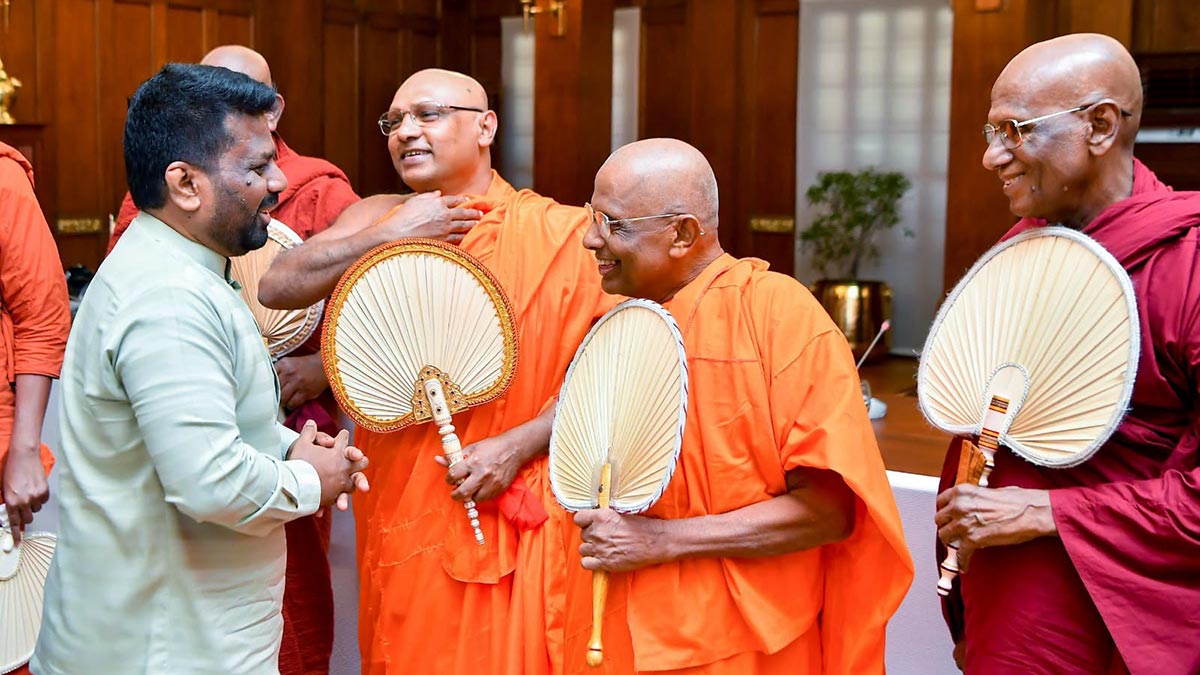
Sri Lanka President Anura Kumara Dissanayake said a committee would propose changes within two weeks to rules on holding Buddhist monks in prison and taking them outside.
He made the announcement during a special discussion with the Maha Sangha at the Presidential Secretariat in Colombo this afternoon (October 8, 2026).
The meeting followed a letter from the Mahanayake Theros to the Commissioner-General of Prisons over the removal of Ven. Galagodaaththe Gnanasara Thero’s robes and his appearance before court in lay attire. The discussion addressed the public reaction to the incident and steps to prevent similar situations.
The President said the committee would include representatives of the Attorney General’s Department, the Ministries of Justice, Public Administration and Buddhasasana Affairs, prison officials and the Commissioner-General of Prisons.
It would study the issue and submit proposed amendments within two weeks, including new regulations and prison standing orders. Provisions affecting Buddhist monks would be discussed with the Maha Sangha before being amended.
Explaining the existing legal framework, the President said prisons were governed by the Prisons Ordinance enacted in 1877, which had been amended from time to time.
He said Section 94 allowed the Minister to issue regulations, which were last amended in 2022. The Commissioner-General of Prisons could also issue standing orders for prison administration, subject to the Minister’s approval.
According to the President, these provisions mainly addressed ordinary prisoners, with only limited reference to religious dignitaries. He identified Regulation 216 as the specific regulation referring to Buddhist monks.
He explained that the clothing issue did not arise for monks held on remand, as they had not been convicted and sentenced. However, different rules applied once a court imposed a prison sentence.
For simple imprisonment, prisoners could choose their clothing with the approval of the prison superintendent. Those serving rigorous imprisonment were required to wear the clothing provided by the prison, he said.
The President said the concern raised by the Mahanayake Theros related mainly to taking monks outside prison, where they became visible to the media and the public. Any changes should therefore cover all occasions when monks were taken outside, rather than only court appearances.
He said he had also examined the circumstances of the 63 Buddhist monks currently in prison. Some were serving sentences for one offence while facing proceedings in other cases, and some had previously been taken to court without their robes.
The President said prison officials had followed the existing laws and regulations and should not be blamed for doing so. However, he acknowledged the shock and distress felt by Buddhists and the Maha Sangha when seeing a monk they had respectfully paid homage to appear in different clothing.
He stressed that he was not prepared to issue instructions for particular individuals that would set aside the law. If existing laws no longer suited present circumstances, the proper response was to amend them through the required process.
“My personal wishes should not become the law,” he said.
The President noted that laws could be changed and suggested that the lack of specific provisions might reflect an earlier expectation that Buddhist monks would not be imprisoned. He added that monks had also been affected, to some extent, by the wider deterioration in society.
He said the proposed rules should apply across the prison system and should not be designed around any one monk.
The President thanked the Maha Sangha for accepting his invitation to the discussion. Speaking on behalf of the Mahanayake Theros, the monks expressed their gratitude and blessings for his prompt attention to the sensitive issue.
Representatives of the three Nikayas attended the meeting, along with Minister of Buddhasasana, Religious and Cultural Affairs Dr Hiniduma Sunil Senevi and Minister of Justice and National Integration Harshana Nanayakkara.