

Sri Lanka’s sugar industry supports 250,000 families, says Deputy Minister
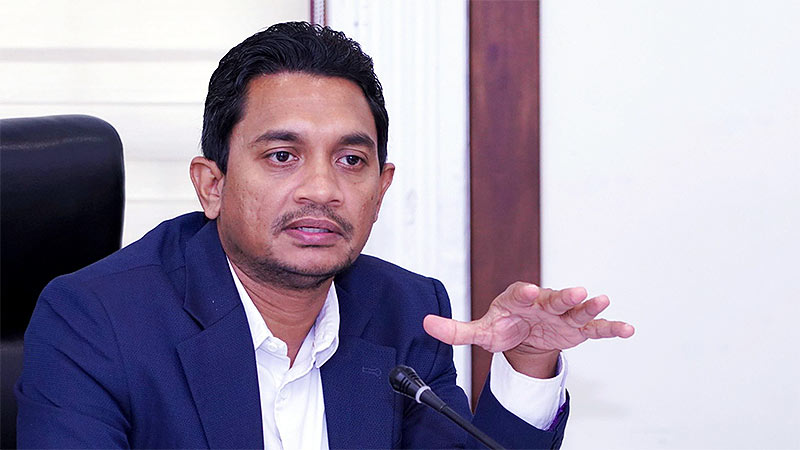
Deputy Minister Chathuranga Abeysinghe
Sri Lanka’s sugar industry contributes around Rs. 11 billion annually to the rural economy and supports about 250,000 families in Monaragala, despite facing mounting challenges from low sugar prices, VAT costs, and increased import competition, Deputy Minister Chathuranga Abeysinghe says.
Responding to recent discussions about the performance of Sri Lanka’s sugar industry, Deputy Minister of Industry and Entrepreneurship Development Chathuranga Abeysinghe said comparisons between the industry’s 2024 and 2025 financial reports do not present the full picture.
He explained that locally produced brown sugar accounts for only about 12% of Sri Lanka’s total sugar demand and must compete with large-scale white sugar producers in countries such as Brazil.
Although the government has imposed a Special Commodity Levy (SCL) of Rs. 50 per kilogram on imported sugar, consumers can still purchase sugar for around Rs. 240 per kilogram. According to Abeysinghe, this makes it extremely difficult for locally produced brown sugar to remain competitive and profitable.
He noted that ethanol production has traditionally been a major source of income for the sugar company. During the economic crisis, reduced sugar imports led to higher sugar prices, with sugar selling at around Rs. 242 per kilogram in 2022, Rs. 304 in 2023, and Rs. 270 in 2024. However, the average factory-out price fell to Rs. 205 per kilogram in 2025.
The ethanol business has also faced difficulties since 2022 due to reduced alcohol production, changing market demand, and quality-related issues. In addition, a decision by the previous government to allow ethanol production from maize reduced demand for locally produced ethanol by approximately 25%.
Ethanol prices have also declined significantly, dropping from Rs. 832 per litre in 2022 and Rs. 890 in 2023 to Rs. 635 per litre at present.
Abeysinghe said another major challenge emerged in 2024 with the implementation of Value Added Tax (VAT). Taxes that had not previously been paid were required by law to be paid in both 2024 and 2025. While the company complied with the regulations, it was unable to pass the additional tax burden on to consumers because higher sugar and ethanol prices would have discouraged buyers.
As a result, VAT became a direct cost to the company, amounting to approximately Rs. 1 billion in 2025 alone.
Despite these challenges, he said operational performance remained strong. The company sold 30,887 metric tonnes of sugar in 2025, up from 25,852 metric tonnes in 2024. It also settled outstanding payments owed to farmers and purchased 578,071 metric tonnes of sugarcane while addressing a number of quality-related issues.
According to the Deputy Minister, the Ministry of Industry and Entrepreneurship Development held several discussions with the Ministry of Finance regarding the VAT issue, but the final economic decision was that VAT could not be removed.
He questioned how the industry could simultaneously supply sugar at Rs. 240 per kilogram, pay VAT, protect farmers, and safeguard jobs.
Abeysinghe stressed that some state-owned enterprises should not be evaluated solely based on profit and loss figures. He pointed out that the sugar industry supports around 250,000 families in the Monaragala area through farmer incomes, transport services, local markets, supply chains, and small businesses.
The industry currently employs 5,028 workers, including 727 casual employees, while the remainder are permanent or contract staff. He emphasized that the present government has not created unnecessary new jobs within the company.
He said the industry contributes approximately Rs. 6.3 billion annually to sugarcane farmers and Rs. 4.3 billion to employees, resulting in an estimated Rs. 11 billion circulating within the rural economy. In addition, it supports temples, schools, public facilities, and the maintenance of elephant fences in the Monaragala district.
The company’s annual economic contribution also includes at least Rs. 1.1 billion in taxes paid to the government.
Abeysinghe further noted that if ethanol were entirely imported instead of being produced locally, millions of dollars would leave the country. He added that the industry also generates indirect taxes, income tax revenue, and wider economic benefits through its distribution network while providing consumers with locally produced brown sugar.
He stated that the current administration inherited an institution facing structural issues, excess staffing, and a non-functioning SAP system that had already cost millions of rupees. He added that no political appointments had been made by the present government.
According to Abeysinghe, the government’s objective is to balance local production, farmer incomes, and consumer needs through efficient management of the existing institution.
He argued that the more important national question is not whether the sugar company records a profit or loss, but what alternative economic opportunities could be created for the thousands of families, farmers, and workers in Monaragala if the industry did not exist.
Referring to the recently discussed “Sugar Store” in Nugegoda, Abeysinghe said wholesale buyers currently purchase sugar from the company at Rs. 205 per kilogram and later package and sell it to consumers at prices ranging from Rs. 270 to Rs. 320.
He explained that the Nugegoda outlet serves as the company’s Colombo distribution hub and is part of a broader plan to expand retail sales. In the future, sugar distributed through the Nugegoda hub is expected to be sold through outlets operated by Samaposha, Milco, and the National Livestock Development Board. The outlet is also expected to function as a collection point for online orders.