

US-Iran two-week ceasefire sets stage for high-stakes Islamabad talks
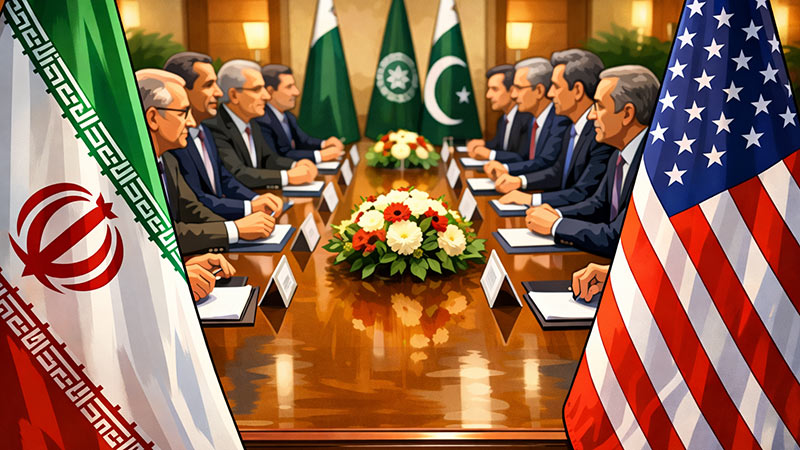
AI-generated image
Iran and the United States have agreed to a two-week ceasefire, with talks set to begin in Islamabad on Friday under Tehran’s 10-point proposal.
The announcement on Wednesday (April 8) followed a statement by US President Donald Trump, who said he would pause attacks on Iran for two weeks instead of carrying out an earlier threat of massive destruction. He said the truce depends on Iran allowing the Strait of Hormuz to reopen fully, immediately and safely.
The Strait of Hormuz is one of the world’s most important shipping routes, carrying about a fifth of global oil supplies. Iran’s partial blockade, put in place after US and Israeli attacks on February 28, 2026 has shaken global trade, pushed oil prices higher and led to fuel shortages in many countries.
The conflict has already spread beyond Iran and the US. Iran’s response has been felt across the Gulf, while Lebanon’s Hezbollah and Yemen’s Houthis have also launched attacks on Israel, drawing more players into the fighting.
Trump said on Truth Social that the US had already achieved and even gone beyond its military goals. He also said Washington was close to reaching a long-term peace deal with Iran. According to Trump, the US has received Iran’s 10-point proposal and sees it as a workable starting point for negotiations. He added that the two sides have settled most major disagreements and that the two-week pause could help complete the agreement.
Iran’s Foreign Minister Abbas Araghchi, speaking for the country’s National Security Council, confirmed that Tehran had accepted the ceasefire plan. In a post on X, he said Iran’s armed forces would stop their defensive operations if attacks on Iran ended. He also said safe passage through the Strait of Hormuz could be arranged in coordination with Iran’s military, and linked the decision to Trump’s acceptance of the general framework of Iran’s proposal.
Pakistan’s Prime Minister Shehbaz Sharif also confirmed the development, saying both sides had accepted an immediate ceasefire in all areas, including Lebanon and other fronts. In a post on X, he said the truce was effective immediately and invited US and Iranian delegations to Islamabad on Friday (April 10, 2026), for talks aimed at reaching a final settlement.
Iran’s National Security Council said its 10-point plan includes Iranian control and supervision over the Strait of Hormuz, which it views as giving the country a special economic and geopolitical advantage. The plan also demands the withdrawal of all US combat forces from bases across the Middle East and an end to military action against armed groups allied with Tehran in the region.
The proposal further calls for full compensation for war damage, the removal of sanctions imposed by the US, the UN Security Council and the International Atomic Energy Agency, and the release of Iranian assets frozen abroad. Tehran also wants any final deal to be approved in a binding UN Security Council resolution.
Even while agreeing to negotiations, Iran made clear it does not trust Washington. The National Security Council said Tehran is entering talks with complete distrust of the American side. It added that the negotiations would last two weeks and could continue longer if both sides agree.
At the same time, Iran warned that its forces are ready to respond with full force if there is even a small mistake by its enemies. Israel has not yet commented on the ceasefire or the planned talks.