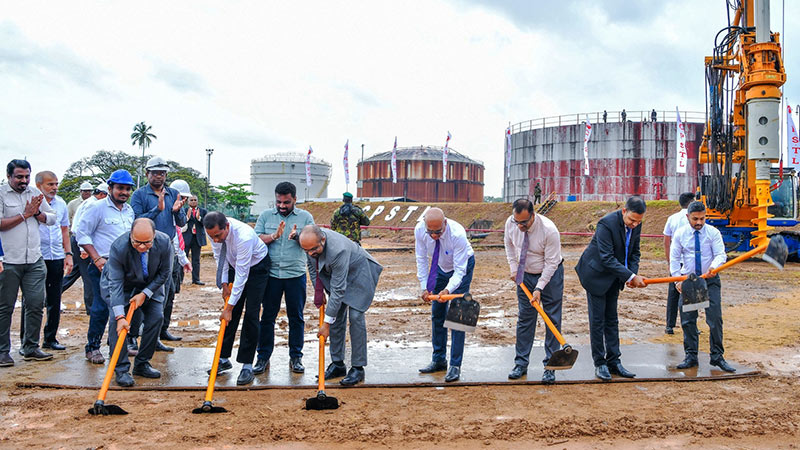

Sri Lanka begins construction of new fuel storage tanks to prevent future crises
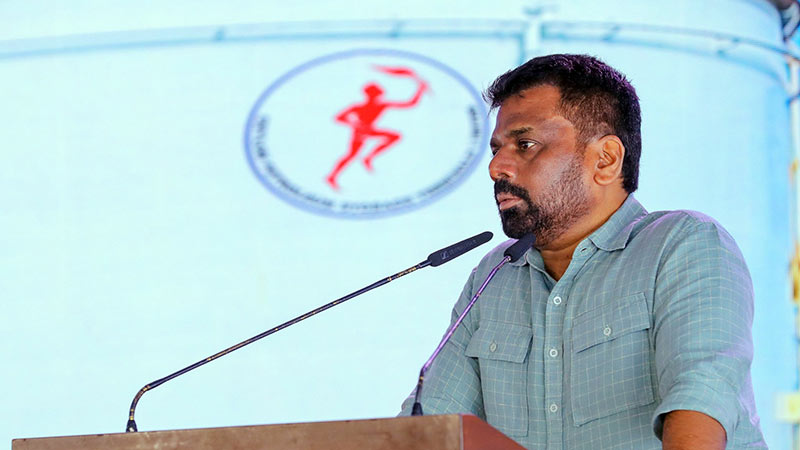
Sri Lanka President Anura Kumara Dissanayake today (September 17) emphasized that a crisis like the one in 2022, where people died in fuel and gas queues due to shortages, will never be allowed to happen again in the country.
The President made these remarks while commencing the construction of six new petroleum storage tanks at the Petroleum Storage Complex in Kolonnawa. The new project includes three tanks of 15,000 cubic meters, two tanks of 7,000 cubic meters, and one tank of 5,000 cubic meters. The construction contract, worth Rs. 3.7 billion, has been awarded to M/s Indo East Engineering – Ceylex Engineering JV, with a 24–month completion period ending in September 2027.
President Dissanayake said the government is working to safeguard both energy sovereignty and economic sovereignty, and he urged the people to support this progressive transformation.
He stressed that the government has a responsibility to meet the people’s energy needs and will not hesitate to make decisions if trade unions obstruct its program. “No institution can move forward only through tradition or human labor. Technology and science must be combined. Mechanization does not make us mechanical beings – we remain human with feelings. While mechanizing institutions, we will also address workers’ concerns,” the President said.
He further pointed out that in the past, employees of the petroleum corporation were pressured to join unions linked to ruling parties and were even used for election malpractices. “Last year, we ended that destructive political culture. Not a single state worker was harassed. Do the people want to go back to that past? If so, they would not have given us 159 seats in Parliament. Some are still unwilling to change, but we will move forward with decisions if necessary,” he said.
The President noted that although the foundation stone for modernizing the Ceylon Petroleum Storage Terminals Limited was laid by an Iranian leader 15–20 years ago, it was never implemented. He said this failure added pressure to electricity costs. The government is now modernizing and expanding the Sapugaskanda Oil Refinery, and scientific experts have volunteered to initiate oil exploration programs.
He recalled that for decades, election campaigns misled people with false claims about oil discoveries. “The first story of oil discovery dates back to the 1970 elections. Today, professionals have been entrusted with these responsibilities and we only provide the facilities,” he added.
Speaking on electricity, President Dissanayake said 26,000 employees of the Ceylon Electricity Board are under one authority, which makes accountability difficult. He said privatization laws affecting the energy sector were passed before his government came to power, and revising them was necessary to protect energy sovereignty.
Electricity costs remain high, but the government is working to reduce them. The President said renewable energy was previously misused for political gain, with licenses sold to unqualified individuals. Now, projects are allocated transparently, cutting costs by half in some cases. For example, a wind power project in the North that cost 8 US cents per unit has been reduced to 4 US cents.
Work has also begun on a 100 MW solar power plant in Siyambalanduwa, the largest of its kind in the country. The project was awarded not to friends or businessmen, but to ensure national benefit. At Kerawalapitiya, plans to convert the diesel power plant into an LNG plant, which would have cut costs by 50 percent, were delayed due to political disputes between the President and Prime Minister in 2015–2019. As a result, electricity costs remain high today.
Looking ahead, the government plans to renovate and use 24 state-owned oil tanks in Trincomalee.
In the last eight months, the Ceylon Petroleum Corporation earned Rs. 18.2 billion in profits. However, since it is not the only fuel supplier, these profits cannot be given directly to consumers. Instead, benefits will be channeled indirectly through education and healthcare.
The President also announced that 33 state institutions that provide no public service will be shut down. Some of these institutions paid salaries only by renting out their land. By 2027, the government will spend Rs. 330 billion on state sector salaries, and he questioned whether such spending benefits the public.
He also said official residences occupied for decades by certain politicians, including former presidents, will be changed as part of efforts to build discipline in the country. “The era of rulers being worshipped like gods is over. Experts must share their knowledge to rebuild this country. It is a crime to remain silent,” he said, stressing that another crisis like in 2022 will not be allowed.
Minister of Energy Kumara Jayakody said the new tanks at Kolonnawa will significantly strengthen Sri Lanka’s fuel storage capacity and ensure a sustainable, efficient, and uninterrupted supply of petroleum products to meet growing demand.
Also present at the event were Ministry Secretary Professor K.T.M. Udayanga Hemapala, Ceylon Petroleum Corporation Chairman and CPSTL Chairman Ananda Rajakaruna, and several ministry officials.